1998 Honda, Nissan, Mazda and German Sedans Face a Five-Lap Track Test
- Cargo
- Electric Vehicles
- Shipped
- Shipper
- [email protected] (Logan K. Carter)
- Readers
- 526
Six 1998 family sedans, from a 177-hp Honda Accord SiR to an Audi A6 and Mercedes E320, go head-to-head on track.
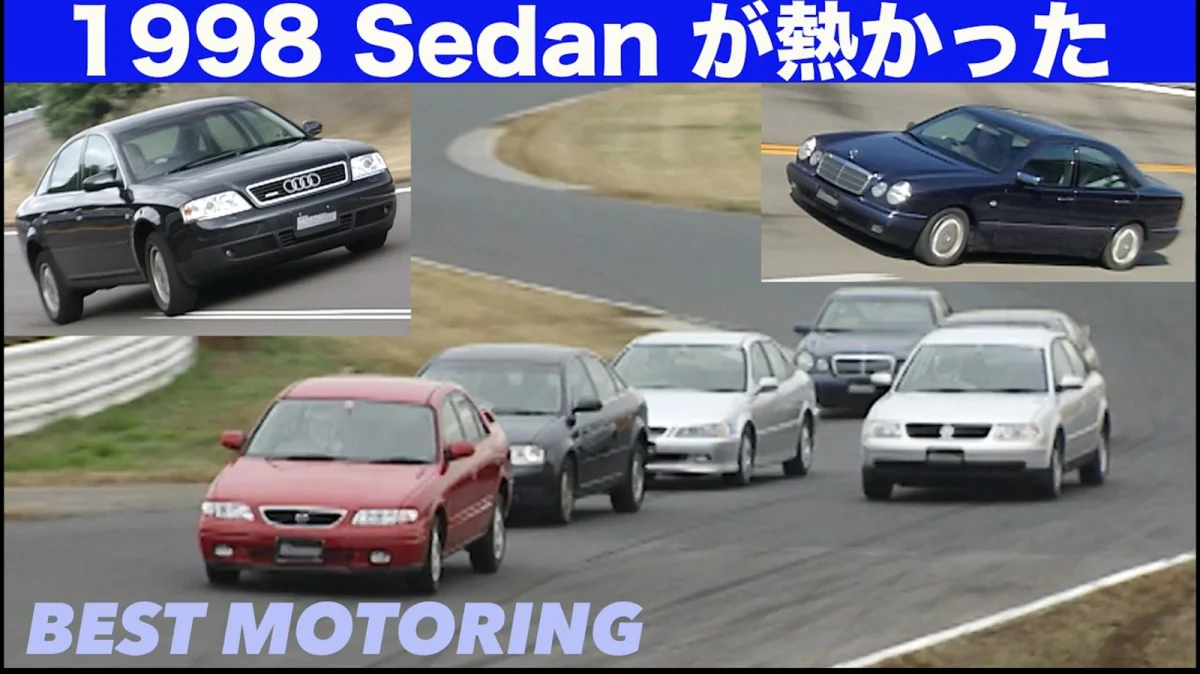
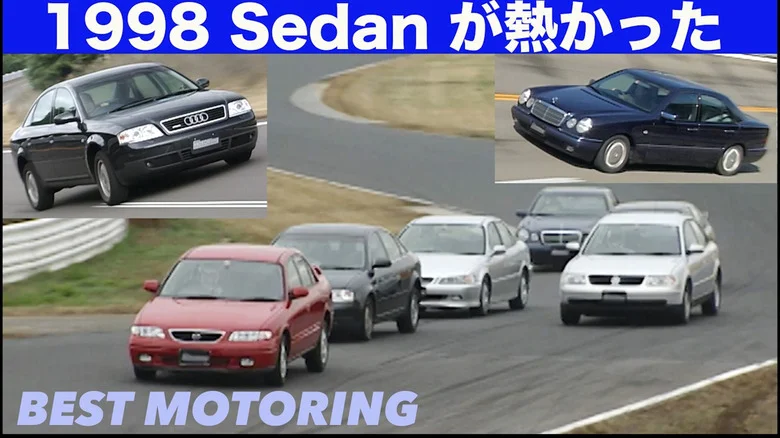
A five-lap track battle puts six very different 1998 family sedans under the same pressure: the Honda Accord SiR, Nissan Primera Camino Te-V, Mazda Capella Zi-R, Volkswagen Passat 1.8T, Audi A6 2.8 Quattro and Mercedes-Benz E320. The Japanese cars provide the performance benchmarks, while the larger German models bring a different mix of size and engineering. It’s an unusually useful comparison because the lineup spans cars that weren’t all direct rivals on the road.
The format comes from Best Motoring, a Japanese car magazine and video series that ran from 1987 to 2011. Its comparison tests put professional racing drivers behind the wheels of competing road cars and send them into close, hard-fought track sessions. Here, the appeal isn’t that these sedans were purpose-built track machines. It’s seeing how ordinary family-car layouts respond when drivers push them well beyond a routine commute.
Four-cylinder benchmarks
The Accord SiR leads the Japanese group on the stated horsepower figures, with 177 hp from a 2.0-liter four-cylinder engine featuring Honda’s VTEC system. Power goes to the front wheels through a five-speed automatic. That combination gives the Honda a clear specification to watch in the test: it has the highest listed output among the three Japanese cars, but it still has to put that power down through the front axle.
The Primera Camino Te-V takes a lower-output approach. Its naturally aspirated 2.0-liter four-cylinder produces about 140 hp and drives the front wheels through a continuously variable transmission. In the United States, the Primera was sold as the Infiniti G20. Its inclusion offers a useful reference point for a smaller, front-drive sedan with a different transmission design from the Honda and Mazda.
The Capella Zi-R makes 168 hp from a 2.0-liter four-cylinder and uses a four-speed automatic to send power to the front wheels. The Capella also has a familiar US connection: it was sold there as the Mazda 626. Its power figure sits between the Accord and Primera, giving the three Japanese sedans a spread of outputs while keeping their basic front-wheel-drive arrangement in common.
Those shared traits make the on-track comparison more revealing than a simple horsepower ranking. Acceleration is only one part of a five-lap contest. A driver also has to carry speed through corners, manage weight transfer under braking and apply power as the car exits a turn. With front-wheel drive, the front tires handle both steering and putting power to the road, so the way each car responds under pressure can matter as much as the number on its spec sheet.
Where the German cars fit
The Passat 1.8T sits closer to the Japanese cars in the comparison, while the Audi A6 2.8 Quattro and Mercedes-Benz E320 represent a larger class. That distinction matters when reading the results: the test mixes cars that may have faced different buyers and expectations, rather than presenting six perfectly matched alternatives.
The source gives no engine output, transmission details or track results for the Passat, A6 or E320, so their relative performance can’t be judged from specifications alone. The Audi’s Quattro name identifies the model in the lineup, but the available details don’t establish how its equipment affected the outcome. The Mercedes is identified as an E320; no further mechanical figures are provided. The video’s driving, rather than a complete set of comparable numbers, is where the differences between these larger sedans and the Japanese benchmarks play out.
That makes this an entertaining test for anyone comparing period cars, but also a reminder of the limits of a single track session. A five-lap contest can show how cars behave when driven hard in the same setting. It can’t, by itself, settle questions about daily comfort, fuel use, maintenance costs, reliability or long-term ownership. Those concerns matter to family-sedan buyers, yet they aren’t answered by the details available here.
A comparison built around the drive
The lineup’s value is its range. The three Japanese sedans bring naturally aspirated 2.0-liter four-cylinder engines, automatic transmissions and front-wheel drive, with outputs from about 140 to 177 hp. The Passat gives the group a closer European counterpart, while the A6 and E320 raise the question of how larger, more expensive-segment cars fare when the track narrows the focus to pace and control.
There’s no need to guess at a winner: the Best Motoring episode shows the six cars in action. For enthusiasts, that’s the point. The specifications set up the matchup; the laps reveal how the cars and drivers turn those differences into a result.