Truckload Spot Rates Rise 4% as Retailers Move Holiday Freight Earlier
- Cargo
- Electric Vehicles
- Shipped
- Shipper
- Zach Strickland, FW Market Expert & Market Analyst
- Readers
- 801
U.S. dry van spot rates climbed more than 4% in early November as retailers moved freight, despite easing diesel costs and falling rejection rates.

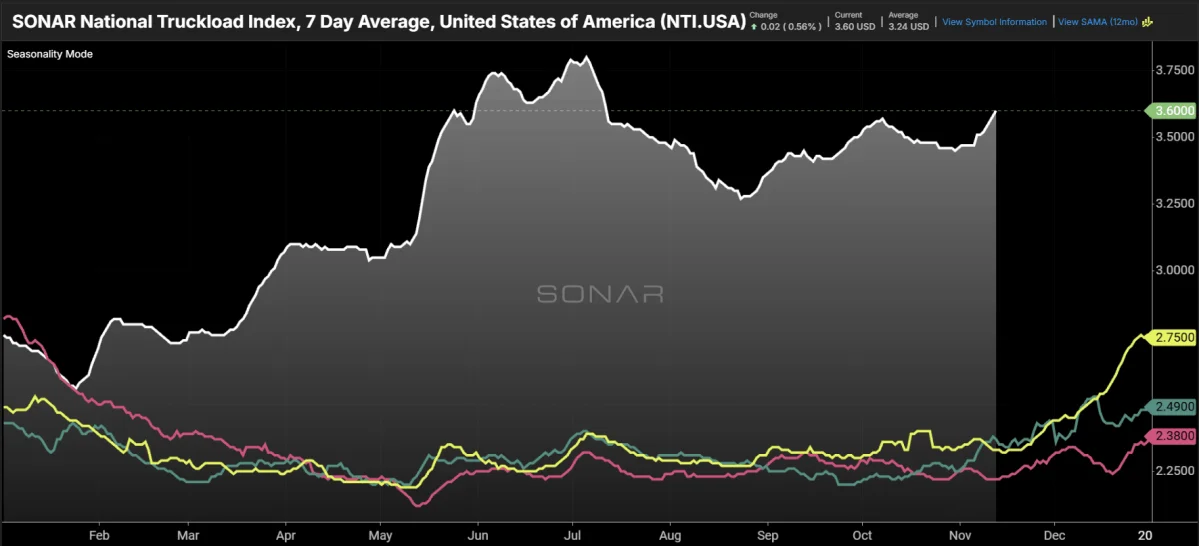
U.S. dry van spot rates reached their highest level since July in early November, climbing more than 4% from late October even as diesel prices fell roughly 3.5%. The timing is unusual: the National Truckload Index (NTI), which tracks dry van spot rate movement across the country, rarely rises this early ahead of the holiday shipping period.
The increase points to a rush of freight into the spot market as retailers work to bring goods through their supply chains before holiday demand peaks. It also highlights a gap between spot pricing and conditions in the larger contract market. For shippers, that gap can make the timing and routing of late-season freight especially consequential.
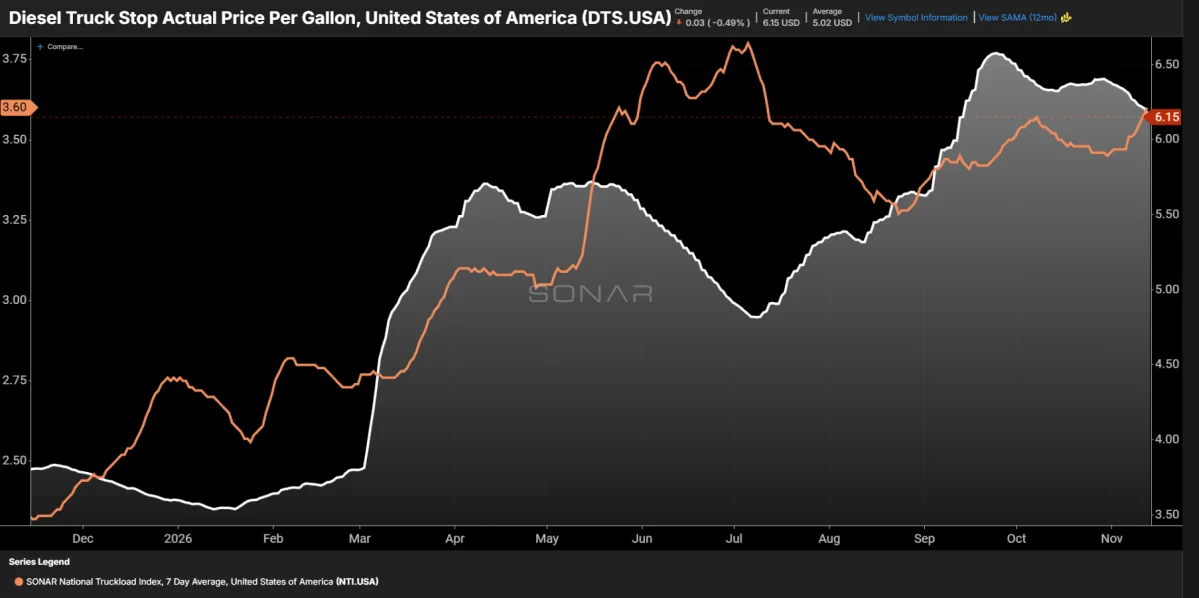
Fuel alone doesn’t explain the jump
Fuel costs are part of the longer-term picture, but they don’t fit neatly as the cause of this recent move. The NTI includes fuel, yet diesel prices have moved down while spot rates have risen. Fuel can affect freight pricing with a delay, but diesel has not recorded a sharp increase since early September, several weeks beyond the typical lag described for that effect.
Carriers also can’t automatically pass higher operating costs on to customers. Their ability to raise rates depends on what the freight market will support. That means a change in spot prices can reflect available capacity and the flow of loads, as well as costs. The current rise appears tied more closely to market activity than to a new fuel shock.
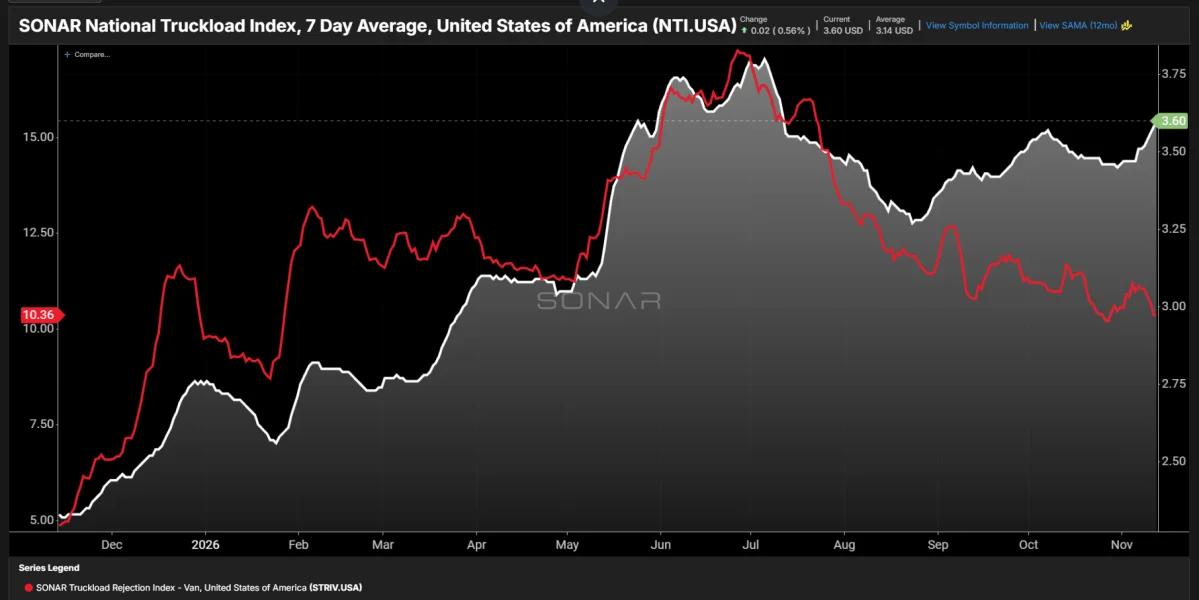
One complication is that national dry van tender rejection rates have been trending down since July, although they remain elevated. Rejection rates above 10% still signal insufficient capacity. Their direction, however, doesn’t have to match spot prices from week to week.
Tender data reflects the much larger contract freight market. Spot freight is a smaller share of truckload activity, estimated at roughly 10% to 25% depending on market conditions. Those markets can respond differently when a burst of freight arrives outside established agreements. A drop in rejections therefore doesn’t rule out a concentrated increase in demand for trucks on the spot market.
Retail inventory timing may be driving demand
A possible explanation is that retailers are bringing freight into the country later than usual and then moving it quickly through domestic networks. Dr. Zac Rogers, co-author of the Logistics Managers’ Index, said on an episode of Freightonomics that many retailers appeared to have delayed inventory arrivals until the last minute.
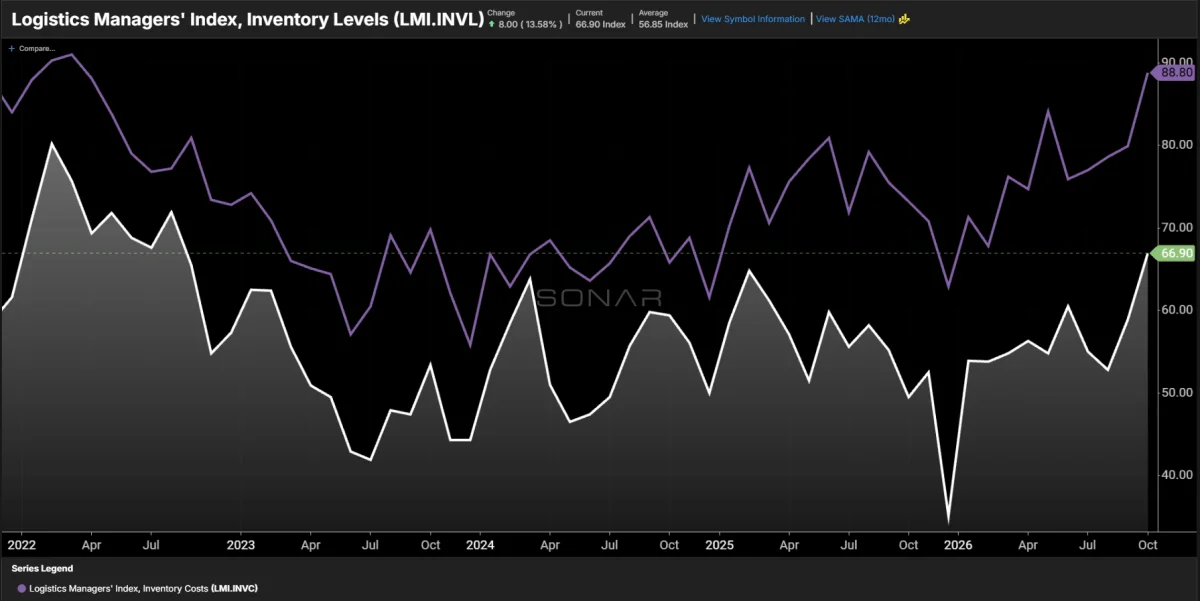
The October Logistics Managers’ Index showed a sharp increase in inventory growth. Its inventory component reached 66.9, the highest reading for that measure since 2022. That figure signals faster inventory growth; on its own, it doesn’t establish how much freight moved by truck or what share was booked on the spot market. It does, however, fit the picture of more goods needing to move as the holiday period approaches.
Retailers have had several reasons to manage inventory cautiously. Uncertainty about consumer demand led some to expect spending to weaken amid inflation, though the overall effect has largely washed out. At the same time, holding inventory has become more expensive. Those pressures encourage just-in-time ordering: bringing goods in closer to when they are needed can reduce storage costs, while making late transportation more urgent.
That tradeoff can be easier to accept when warehousing and inventory costs are high. Intermodal has benefited from elevated trucking and warehousing costs, with volumes growing by double digits compared with 2025 levels. A late wave of orders could therefore affect different transport modes in different ways, depending on timing, route and the need for speed.
Supply chains have also become more streamlined and flexible since COVID, Rogers said. Better coordination can help shippers move goods through their networks with greater precision, reduce transit time and postpone orders. That flexibility offers control over inventory, but it can concentrate transportation demand when many shipments are released close together.
Holiday timing and rail shifts add uncertainty
With the holiday shipping season nearing and truckload conditions still short of a full recovery, shippers may be trying to avoid the cost of waiting until the week before Thanksgiving. If more companies move freight earlier, that could help explain why spot rates are rising even as tender rejection rates trend lower. The pattern suggests that timing and the type of freight entering the market matter alongside broad capacity measures.
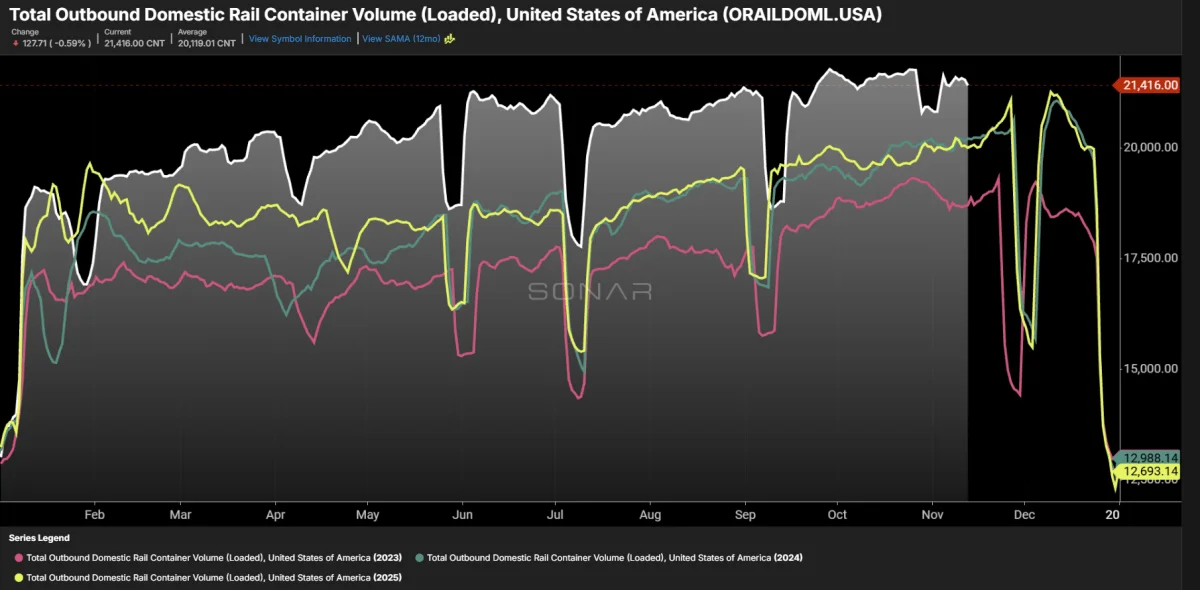
Some of the additional truck demand may also come from freight shifting back from rail after recent disruptions involving BNSF and CSX. Domestic container volumes have not fully recovered and appear to be reaching a ceiling. That differs from the previous two years, when domestic container volumes continued to grow into December.
The spot rate increase doesn’t, by itself, show whether the market has entered a sustained recovery. It does show that a short-term rush of loads can lift prices even while contract market indicators are easing. For the holiday period, the key signals to watch are whether spot rates continue climbing, whether tender rejections turn upward, and whether delayed inventory and rail diversions keep feeding truck demand.