F1 Commits £2.4m to Engineering Scholarships in First Social Impact Report
- Cargo
- Electric Vehicles
- Shipped
- Shipper
- The Race Team
- Readers
- 936
F1 renews £2.4m in engineering scholarships for three years, adding 10 places a year. Its first social impact report cites 500,000+ participants.
The headline number is the £2.4 million, but the structure matters more. F1 has renewed its Engineering Scholarships on a firm three-year footing, and the timing is notable: the commitment landed alongside the first social impact report the sport has published. That pairing tells you F1 wants its community work judged on measurable outcomes, not on press-release goodwill.
What the scholarships actually cover
The programme launched in 2021 and pays for full higher-education tuition alongside living costs for students from underrepresented backgrounds. Since then it has supported 48 students. The renewal lifts the intake to 10 new scholarships a year, running up to and including the 2028/29 academic year. That's a meaningful increase in throughput for a scheme still in its relatively early life, and it gives candidates a predictable multi-year pipeline rather than a one-off grant.
The participating institutions are the University of Strathclyde, Imperial College London, the University of Cambridge, the University of Oxford, and the Motorvehicle University of Emilia-Romagna (Muner) in Italy. Including a specialist automotive university alongside the UK's research-intensive institutions is a sensible choice for a series that lives or dies on engineering talent. Muner in particular speaks directly to the vehicle and motorsport sector that F1 draws its technical workforce from.
The student perspective
A first-year F1 engineering scholar at Oxford offered the clearest sense of what the money does day to day. "Words cannot describe how much this scholarship has changed my life," they said. The scholar tied their first-year success to the removal of financial pressure, saying that covering all the costs of Oxford let them concentrate on the course rather than worrying about whether they could afford their next meal. That kind of practical detail is worth noting for anyone assessing how well a bursary works in practice: the value isn't only in tuition, it's in removing the background stress that quietly erodes performance in the first year.
Race weekends as outreach platforms
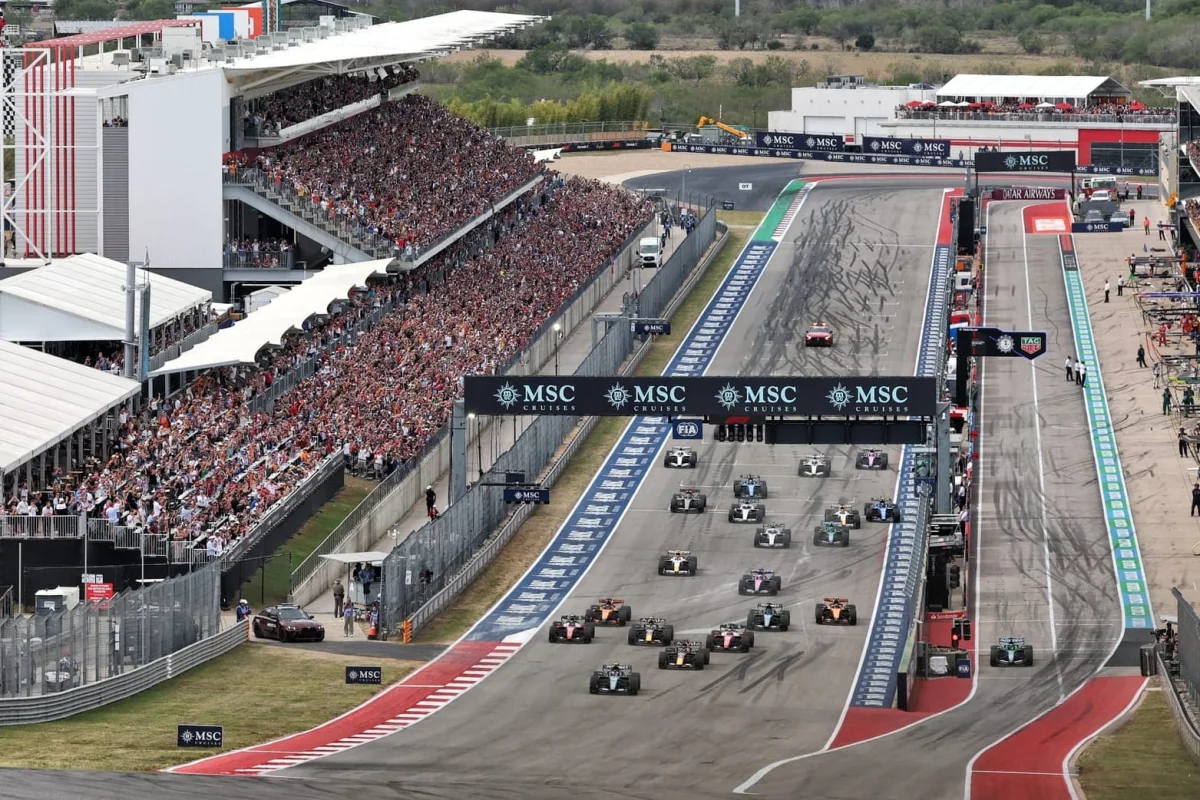
The report says all 24 host grands prix ran social outreach programmes. So did each of last year's 10 teams, along with F1 and the FIA. That breadth matters because it moves community work out of a single flagship initiative and into the operating routine of the calendar and the paddock. Whether every programme is equally substantial is harder to judge from a summary report, but the scale of participation across the sport is the headline.
Learning Sectors goes wide
The most quantifiable initiative in the report is the Learning Sectors programme, developed with the British Council. It launched in January of last year and rolled out across schools in the UK, South Africa, India and Brazil. The format is cross-border: STEM-inspired projects and coding competitions aimed at students aged seven to 16, deliberately drawn from underrepresented backgrounds, with the goal of building computational thinking.
F1 says more than 150,000 students from over 700 schools have taken part so far. Across 2026 and 2027 the programme is set to expand into China, Mexico and Spain, adding another 250,000 students. Here's the thing: scaling an education programme across that many countries usually comes down to teacher training and local delivery, not the headline content. Watch whether the expansion holds quality as the numbers climb, because programmes of this type often thin out when reach grows faster than support structures.
Smaller, sharper schemes
The Next Grand Prix, launched in 2022 with the Social Mobility Business Partnership charity, takes a narrower approach. Students pitch a new F1 race location in a competitive format. More than 600 students have received placements since launch, 126 of them in 2025. The initiative won F1 the Innovation Award at the UK Social Mobility Awards, and one alumnus is now a management consultant trainee associate at the Big Four accounting firm PwC. That outcome is the kind of evidence that makes the case for programmes like this with employers and funders alike.
Promoters have their own community angles too. The Miami Grand Prix's MIA in Schools initiative aims to bring students into engineering, design and marketing. It supported 21 undergraduate and graduate students through its academy and hosted 150 local guests who joined them for the Thursday of last year's race. Miami also selected 15 local small businesses as food and drink vendors, 10 of which are either fully or partly owned by women. For a race weekend, that's a practical form of local economic engagement, and it's easy to measure.
In Las Vegas, the GP launched an F1 Drive Karting Camp that hosted 240 teenagers from the 13 Boys & Girls Clubs of Southern Nevada. Youth clubs are a sensible channel for reaching teenagers who might never otherwise encounter motorsport, and the karting format gives them a hands-on entry point.
What to watch next
My read is that the scholarship renewal is the most concrete piece of this report, because it has a fixed number of places, a clear end date and named universities. The school programme is the most ambitious, and its expansion into China, Mexico and Spain will show whether the model travels. The race-promoter schemes are harder to compare, since each reflects its host city's priorities. Taken together, the report gives F1 a clearer baseline for future claims. The next useful test is whether the figures are updated with the same level of detail in the years ahead.