Ford Racing's Megazilla 2.0 Crate Engine Tops 1,200 HP
- Cargo
- Electric Vehicles
- Shipped
- Shipper
- Jim Campisano
- Readers
- 586
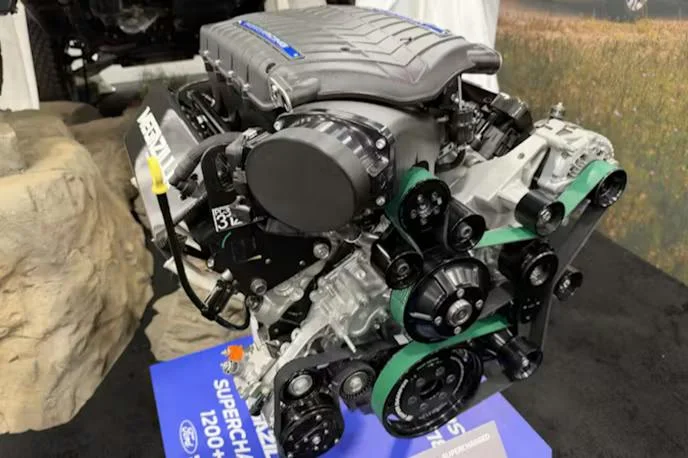
Ford Racing's supercharged Megazilla 2.0 crate V8 makes over 1,200 hp and 1,000 lb-ft, with a reworked block and a Whipple Gen 6 3.0-liter blower.
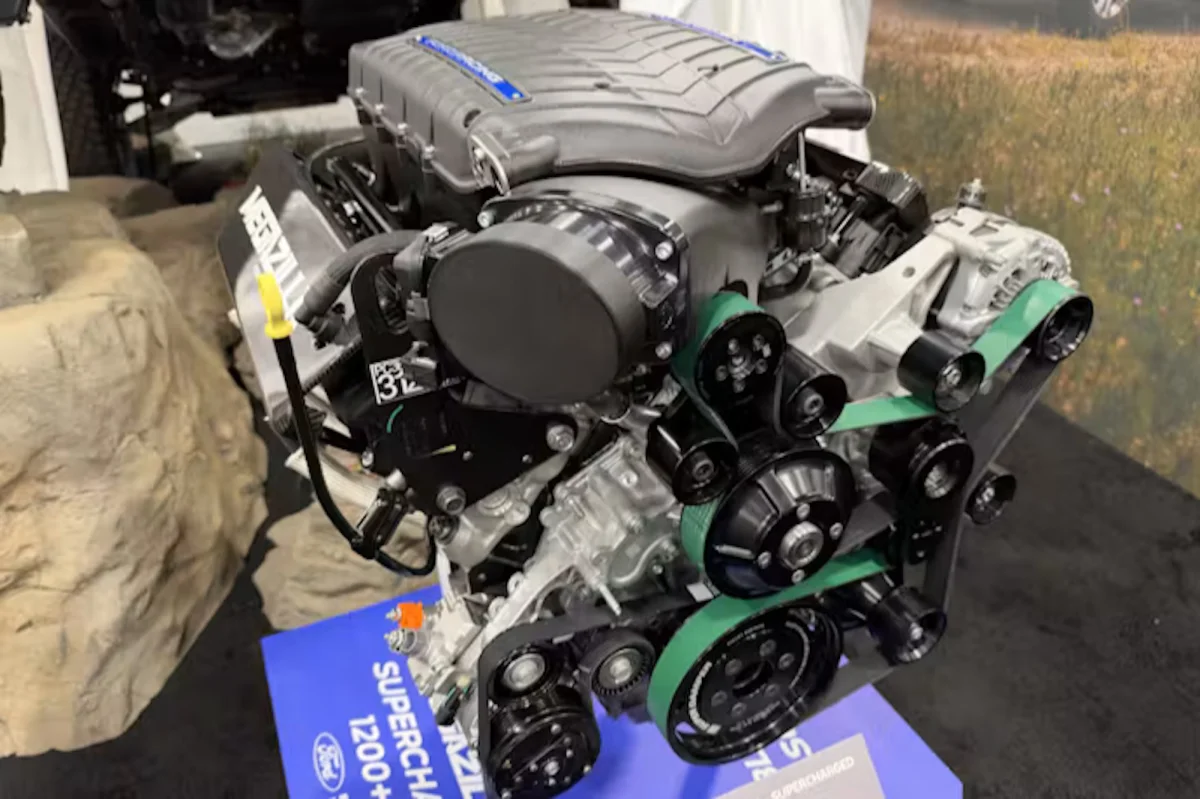
Ford Racing has taken its Megazilla crate engine past four digits. Megazilla 2.0 is rated at more than 1,200 horsepower and over 1,000 lb-ft of torque, which makes it the most powerful crate engine an automaker has built. The bigger story is how it got there. This isn't a blower bolted onto the 2022 engine. It's a separate development program with its own block machining, internals and supercharger package.
From 615 Horsepower to Four Digits
The first Megazilla arrived in 2022 as a 615-horsepower version of the 7.3-liter Godzilla V8, the same engine offered in Super Duty pickups. It stayed naturally aspirated but picked up durability and performance upgrades. Megazilla 2.0 changes the equation. Its centerpiece is a Gen 6 3.0-liter Whipple supercharger, and Ford Racing showed the supercharged engine at this year's SEMA Show in the Frostwarden Bronco build. Dropping a crate engine of this size into a late-model Bronco is an unusual choice, and it's a clear demonstration of what the package can handle outside a classic-truck setting.
Michael Goodwin, Ford Racing's Parts Product Manager, described the brief in plain terms. "I tasked the engineering team with making me at least 1,200 horsepower using the 7.3-liter platform, and they've really delivered." He also pushed back on the idea that this is a simple upgrade. "This isn't just Megazilla 1.0 with a supercharger bolted onto the top. It had its own separate development program. We upgraded a lot of components, and the block has some machining differences."


Inside the Rotating Assembly and Heads
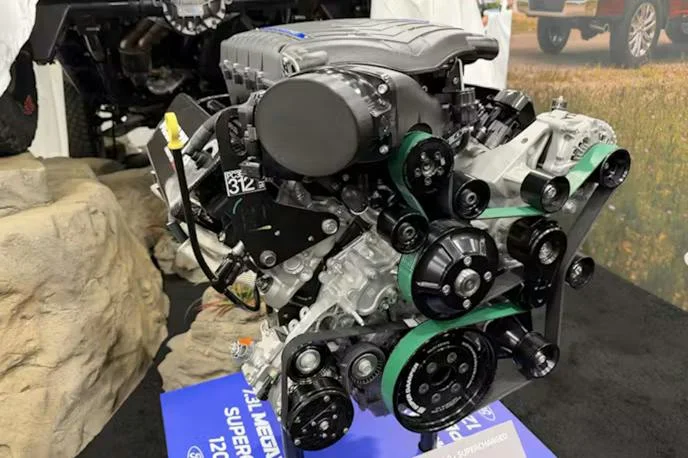
Start with the bottom end. Mahle forged pistons bring the compression ratio to 10.5:1, a figure that makes sense for a blown engine. Boost adds cylinder pressure on top of the static ratio, so a builder typically runs a lower number than a naturally aspirated engine would need. The rods are Callies H-beam units, and the camshaft is a custom Ford Racing design built for boost rather than carried over from the original Megazilla. Ford also moved to a new alloy for the forged pistons, which matters when the combustion loads climb this high.
Up top, ARP 2000 head studs clamp CNC-ported aluminum heads to the block. Larger fuel injectors feed the extra air the supercharger moves, and Ford added a new 10-rib front accessory drive. The belt drive and damper were revised to handle the load a blower puts on the front of the engine. None of this is glamorous, but anyone who has tried to scale a crate motor knows the accessory drive and damper are where a build starts to fail if they're treated as an afterthought.
The Block Gets Reworked
The block carries the most visible changes. Ford Racing's improved block (P/N M-6010-SD73R) is machined differently from the production 7.3-liter casting. The production block has a saw cut between the cylinders to help with cooling. Megazilla 2.0 eliminates that cut to improve sealing between the cylinders. That's a sensible trade. At four-digit output, keeping the bores sealed under pressure is a bigger concern than shaving cooling flow, and the cylinder walls are where a high-boost engine tends to show its limits first.
Goodwin pointed to the bones of the block as well. "The block itself is a very good foundation for high-performance builds. It's a deep-skirt design, and each main cap has six bolts: two on the sides and four underneath. Everything is checked to make sure it meets our specified tolerances. Any block that doesn't meet those checks is rejected and isn't used in an assembly." A deep skirt and six-bolt main caps add rigidity to the crankcase, which helps keep the bottom end stable when torque loads spike.
Where It Fits and What It Means for Builders
Megazilla 2.0 is aimed at a different crowd than the typical crate-engine buyer. The 7.3's narrower overhead-valve architecture and compact dimensions are a big part of its appeal to people working on classic Fords, where packaging a modern engine can be a headache. Goodwin said it's a natural fit for trucks and street rods, and noted that the team has already built a Galaxie convertible with one. Early Mustangs, Torinos, F100s and full-size Fords all sit on the list of likely candidates.
For those projects, the engine is only part of the job. Teams in this position typically start rethinking the drivetrain as soon as the horsepower figure is confirmed. Clutch or torque converter capacity, transmission strength, driveshaft and rear end all need to match a 1,000-lb-ft engine, and the tuning, cooling and fuel system will need to keep pace with the supercharger's demands. The rear end is where the real cost tends to sneak up on a build of this type, and the engine's rated output is a reminder to size every component around it, not just the motor.
What to Watch Next
My read is that Megazilla 2.0 matters less as a headline number and more as a template. A stronger block, boost-specific internals and a purpose-built accessory drive give Ford Racing a platform it can adapt for other applications, and the Bronco showing suggests the team sees a wider audience than traditional hot-rod builders. Prospective buyers should confirm current pricing, availability and supporting parts directly with Ford Racing before planning a build around it. The four-digit club has become a crowded place, and this engine's advantage will come down to how easily it drops into real projects and how well the supporting hardware keeps up with the numbers.