Fuel Is Driving Most of the Fall Intermodal Rate Climb
- Cargo
- Electric Vehicles
- Shipped
- Shipper
- Zach Strickland, FW Market Expert & Market Analyst
- Readers
- 940
Intermodal contract rates jumped 9-12% this fall, and fuel explains most of it. Intermodal still undercuts truckload by about 30%, but the cushion is narrowing.
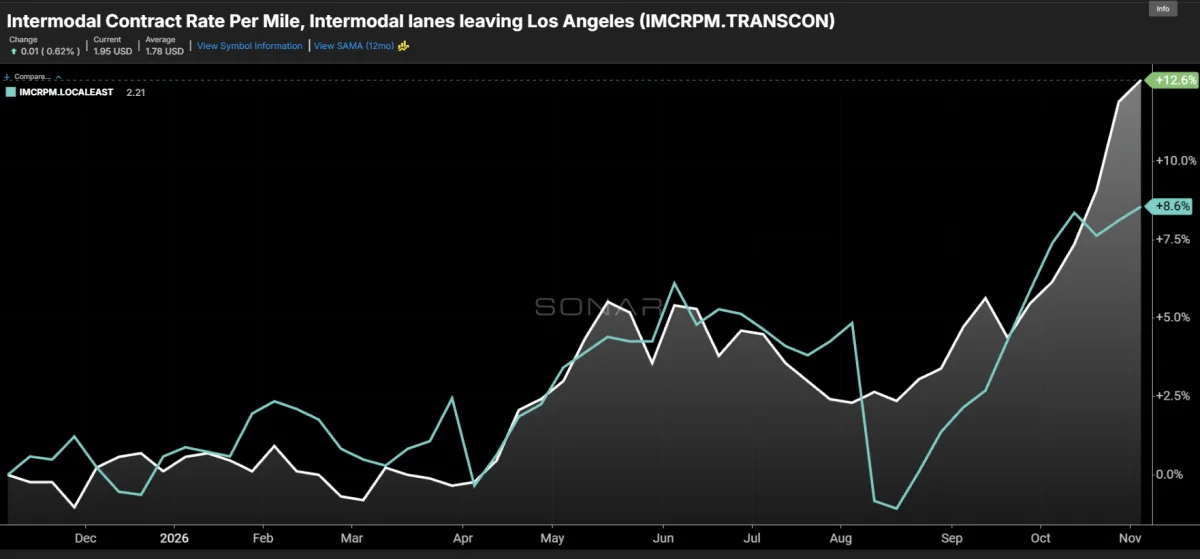
Intermodal contract rates, fuel included, have moved sharply higher in the fourth quarter. Transcontinental lanes are up more than 12% year over year, and the shorter Eastern lanes are up close to 9%. Those are big numbers for a market that usually resets once a year. But the headline increase is mostly a fuel story, and once you strip fuel out, the picture looks much calmer.
The indices behind these figures, IMCRPM.TRANSCON and IMCRPM.LOCALEAST, are built from invoices that include fuel surcharges. That matters because invoices trail actual freight movement by a few weeks. Diesel moves show up in the data late, and you can see that lag clearly in the last year of readings.
Diesel is writing the rate sheet
Diesel rose roughly 50% in March and April. The transcontinental contract index followed with a 6% increase from April to May. Later, diesel climbed about 36% from July to September, and the index added 10% between August and October. The timing is consistent enough that fuel is clearly the main driver.
Based on how closely the indices have tracked diesel, fuel accounts for roughly two-thirds of the transcontinental increase and about three-quarters of the Eastern increase. Strip it out and transcon is up about 5%, while Eastern is up about 2%. That's a very different story from the headline, and it's the number I'd focus on if you're benchmarking a contract.
There's a wrinkle here. A common published intermodal fuel surcharge schedule would imply a fuel effect larger than the entire increase in either index. That doesn't add up unless many larger shippers have negotiated their own, less aggressive surcharge tables. My read is that the big accounts are paying a lot less fuel add-on than the public schedules suggest, and that's why the indices look as tame as they do outside of fuel. It also means your surcharge schedule could matter as much as the base rate when you compare offers.
Why the big carriers didn't get bigger increases
J.B. Hunt, which runs a large intermodal book, said it secured only low-single-digit rate increases in the bid season that closed in September. That lines up with what the data should be showing, since the indices capture the front end of newly signed contracts. Here's the thing: the total rate was already elevated before the bid season, and surcharges were doing most of the heavy lifting. Carriers had less room to push base rates when fuel was already pulling the all-in number up.
That creates a real dilemma for both sides when fuel is volatile. A larger fuel surcharge share means more price swings. But if a contract gets set while fuel is high, the total rate has more room to fall over the contract's life as diesel eases. A smaller fuel share keeps costs steadier through the year, but shippers then get less benefit when fuel drops. Fuel surcharges were never meant to be a profit center. They're a mechanism for splitting fuel risk between the two parties, and the split is what gets negotiated.
Intermodal still has room to look cheap
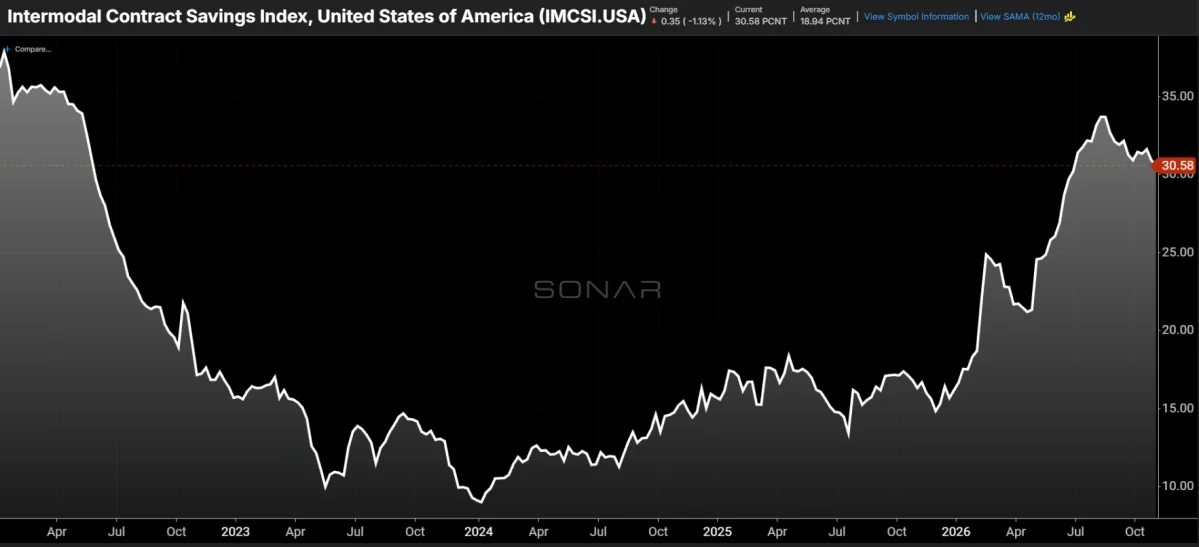
Even after these jumps, intermodal is still well below trucking on cost. The Intermodal Contract Savings Index (IMCSI), which compares average rates on comparable truckload and intermodal lanes, shows intermodal running about 30% cheaper. That's down only slightly from a peak of 33% in June. In plain terms, the gap has narrowed a little, not closed.
That leaves room for rates to climb further and still stay competitive with trucking. Most of the recent increases should show up fully in the data over the coming weeks, which will give a cleaner read on where intermodal lands against truckload. My expectation is that intermodal stays a strong cost-saving option for the foreseeable future, though the margin will be worth tracking lane by lane. The Eastern lanes have less cushion than the transcon in fuel-adjusted terms, so the comparison depends a lot on where your freight actually moves.
Rail disruption is the other variable
Rail service carries its own risk. A weather-related washout on BNSF in New Mexico and a technical outage at CSX are reminders that rail networks can be knocked out just as trucking lanes can. If you've shifted freight to intermodal to save money, it's worth having a backup plan for the lanes where you can't afford a delay. Dual-sourcing rail and truck capacity on critical freight is a common hedge, and it costs less than most shippers expect when the alternative is a stalled shipment.
So far, shippers don't seem bothered. Volumes have largely recovered from earlier dips, and growth is running around 7% annualized. That suggests customers are willing to absorb higher all-in rates in exchange for the savings intermodal still delivers, at least for now.
What I'll watch next is how much of the fall increase survives once fuel prices settle. If diesel stays volatile, expect shippers to push harder on surcharge tables in the next bid cycle. If it eases, the total rate could drift back down on contracts signed at today's levels, and that would be the real test of how these agreements were structured.