Freight Cycles Keep Breaking the Rules
- Cargo
- Electric Vehicles
- Shipped
- Shipper
- Zach Strickland, FW Market Expert & Market Analyst
- Readers
- 881
Since 2000, freight cycles have refused to repeat neatly. Demand and truckload rates now point to a new upturn, and timing it remains a guessing game.
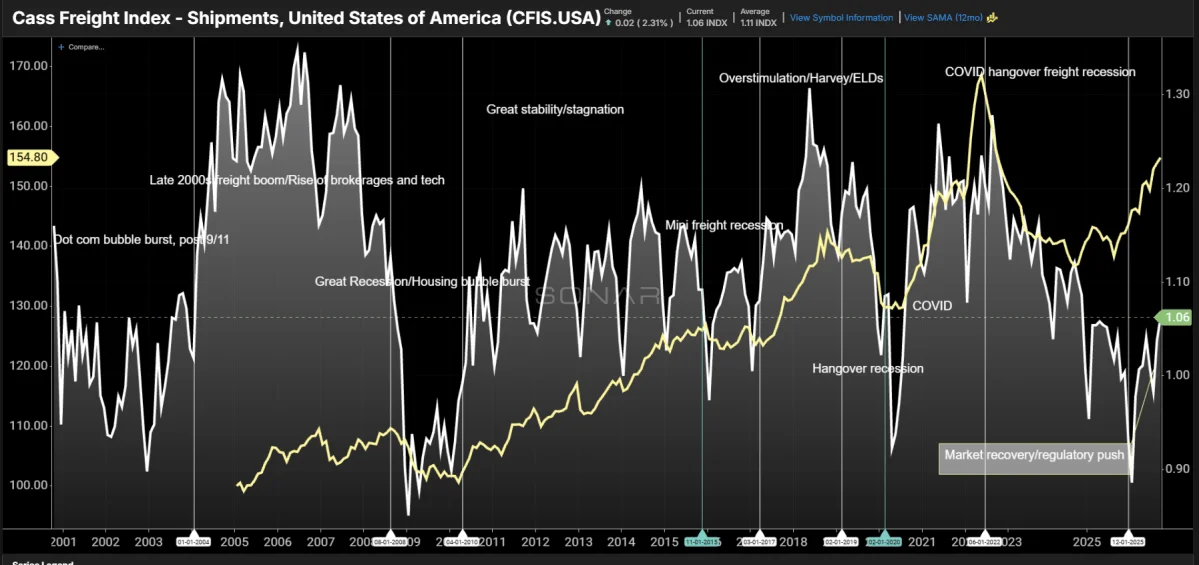
Plot the Cass Freight Shipments Index (CFIS) against the Cass Truckload Linehaul Index (CTLI) for the past 25 years and you get a rollercoaster with no fixed rhythm. Each downturn and recovery has its own shape, which is exactly why calling the start or end of a cycle remains so hard. The two indices tell different halves of the story, and reading them together is the only way to see why.
The CFIS tracks shipments across truckload, intermodal, LTL and several smaller modes, so it works as a broad measure of transportation demand. It's built on invoice data, which means it trails real activity by a bit. The CTLI strips out fuel and accessorial charges and looks only at the base cost of a truckload move. That makes it a cleaner read on supply and demand in truckload itself, because fuel swings can otherwise distort the picture.
Recession, then a boom that set the tone
The 2000s opened with the dot-com collapse and the economic fallout from 9/11 pulling the economy into recession. Goods demand stayed soft longer than the broader economy did, a pattern that would recur later in the cycle.
By 2004, conditions had turned strongly positive. Low interest rates after the weak start to the decade fed a housing boom, and fuel prices grew volatile even as real GDP grew about 3.8%. Strong goods demand combined with limited capacity pushed freight brokerages beyond their role as a backhaul outlet for carriers. Brokers leaned on technology that had become far cheaper and easier to access as the internet matured. That connectivity let smaller carriers haul for larger shippers and helped drive owner-operator growth through the following decade.
The housing market collapse in 2008 set off the Great Recession, and weakness lingered into 2010. Recovery took hold in early 2011, and the economy grew slowly but steadily for the next five years.
The stable years that became the benchmark
That post-recession stretch was the steadiest period in the past 26 years, and it shaped what many people in the industry still think of as normal. The CFIS followed a clear 12-month seasonal pattern, and base truckload rates rose about 3% a year until 2016. If you started your career in that window, predictability probably felt like the default.
It wasn't. Energy markets collapsed in late 2015, and a mini freight recession ran through most of 2016. Many participants didn't recognize it until it was over. Economic growth slid from roughly 4% in early 2015 to about 1.5% a year later, industrial activity struggled, and truckload base rates fell around 2% as demand faltered.
Then the balance flipped. By early 2017, capacity had tightened and demand was coming back. A major tax overhaul signed that December added fuel heading into 2018, and rising demand met shrinking capacity. The result was one of the strongest and longest spot-rate upswings in modern history. Weather disruption and the electronic logging device rule tightened conditions further that fall and winter. Plenty of people wrote the period off as a one-off that wouldn't come around again.
It came around, and then it unwound. The tax cuts gave the economy a temporary lift, but strong rates had drawn in new operators. Active trucking authorities rose about 15% between early 2017 and early 2019. That supply surge, combined with softening demand, produced the 2019 freight recession. It also claimed some of the biggest trucking failures of the century at the time, including truckload carrier Celadon and LTL carrier New England Motor Freight. Capacity was leaving the market just as the next shock was about to hit.
The pandemic cycle broke the model
COVID was the second black-swan-style event in roughly three years, which is a hard argument against treating such shocks as rare. Stimulus payments, enhanced unemployment benefits and the shift to working from home drove an unprecedented surge in goods demand and strained supply chains. An already tight market got tighter, and the boom eventually gave way to what became the longest freight recession of the 2000s. It ran from early 2022 through the 2025 holiday season.
The industry is now about a year into a new cycle, and the data shows why trying to pin down a timeline is a fool's errand. Tighter rules on who can operate, diesel prices and interest rates all play a part. Demand remains relatively weak, which sits awkwardly with an inflationary environment. According to the CTLI, truckload rates were up 10% in September while volumes rose only 2%. That gap is the signal to watch: rates rising faster than the freight moving underneath them.
The lesson from the past 25 years isn't that cycles follow a formula. Freight doesn't sit apart from the rest of the economy. It responds to energy prices, credit, consumer behavior and policy changes, often in ways nobody predicted. Planning around the 2010–2015 environment returning would be a risky bet for any carrier or shipper.
Timing matters less than the trend
Historically, 12 months looks like the minimum for how long a cycle of this kind lasts. With demand still near the bottom of its range, an upside economic surprise could stretch this one by several months. Anyone expecting rates to ease quickly is effectively betting on a broader economic slowdown and the revenue hit that would bring to businesses. That's a bet finance teams should price in explicitly rather than hope away.
For operators and shippers, the practical move is to watch the spread between rate and volume movement, track demand indicators like the CFIS alongside the CTLI, and avoid planning around a single expected turning point. Cycles this irregular reward flexibility more than forecasting.
Data in this piece comes from the Cass Freight Shipments Index and Cass Truckload Linehaul Index, presented via SONAR.