Truckload Capacity Shows No Sign of Recovery Ahead of Peak Season
- Cargo
- Electric Vehicles
- Shipped
- Shipper
- Zach Strickland, FW Market Expert & Market Analyst
- Readers
- 375
Truckload rejections sit near 13.9% even as accepted volumes slip. Supply, not demand, is driving the tight market, and shippers should plan for it lasting into 2027.
Truckload capacity isn't loosening. Accepted volumes are falling into the holidays, and rejection rates haven't budged. In a normal market, that combination would mean carriers have room to breathe. Right now, it means the market has very little slack left to absorb a shock.
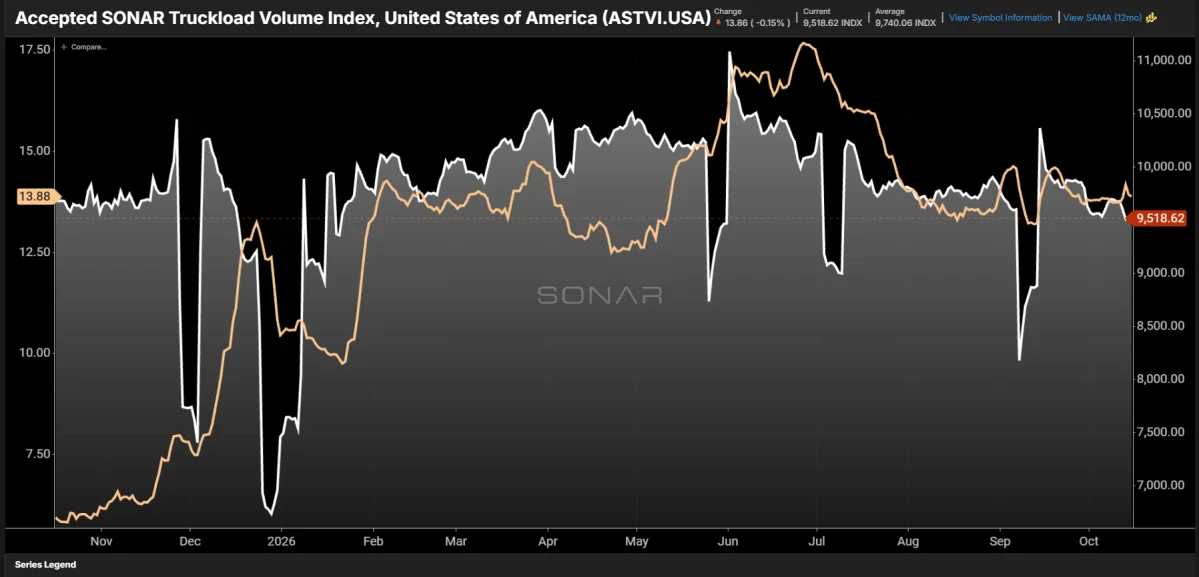
The Accepted SONAR Truckload Volume Index (ASTVI), which counts only the loads carriers actually accept, has dropped more than 4% over the past four weeks to 9,518. That's its lowest reading outside a holiday week since January. The national rejection rate (STRI) has barely moved and is holding near 13.9%. Those two lines moving in opposite directions is what catches my attention.
Look at where the market stood a year ago. Rejections were under 6% entering peak season, and the ASTVI was roughly 2% higher. Compare that with today and the picture is clear: the market has regained little, if any, efficiency over the past twelve months.
How this cycle differs from COVID
It's tempting to line this up against the pandemic-era squeeze, and the comparison is instructive, though not in the way many expect. In the early COVID phase, carriers appeared to hit their ceiling with the ASTVI around 11,500 in the fall of 2020. Rejection rates were near 25%, a clear sign that demand was running well ahead of what carriers could physically move.
By spring 2021, carriers were accepting more than 10% additional loads, even with rejections still elevated. That market was tighter than today's in several respects. Even so, after eleven months of elevated rates, most people would expect accepted volumes to have recovered more than they have.
The biggest difference is what drove each cycle. The COVID tightening was demand-led. Tender volumes rose nearly 50% year over year between September 2019 and September 2020, while accepted volumes climbed 20%. That surge consumed the slack in what had been an oversupplied market almost immediately.
The current cycle is the reverse. Demand isn't the engine. Trucking volumes were actually softer, yet rejections and spot rates ran well above the previous three years by the 2025 holiday season. Many in the industry questioned that signal at the time because it didn't match the freight picture. Winter Storm Fern in late January then pushed tender rejections and spot rates higher, and neither has meaningfully pulled back since. Here's the thing: a weather event can tighten a market, but it doesn't explain why the market stayed tight. That points back to capacity.
Higher barriers to entry
The other structural break from the last inflationary cycle is how hard it has become to add drivers. English language proficiency enforcement, stricter rules on non-domiciled CDLs and tougher immigration rules are keeping a large pool of potential drivers out of the industry. In past cycles, a rate spike pulled new capacity in fairly quickly. This time, the pipeline is narrower by design.
The Montgomery v. Caribe ruling adds an indirect effect. Brokers are now less likely to work with carriers that have weak safety records, which trims the pool of available trucks. According to GenLogs, close to 2% of carriers with substandard safety scores had been removed from service as of this past summer. That's a small share of the total, but it's a meaningful one when the market has so little cushion.
Costs are squeezing the carriers who are left
Capacity that exists still has to make money, and that's getting harder. Diesel has spiked at times, and for smaller carriers the cash flow pressure is immediate.
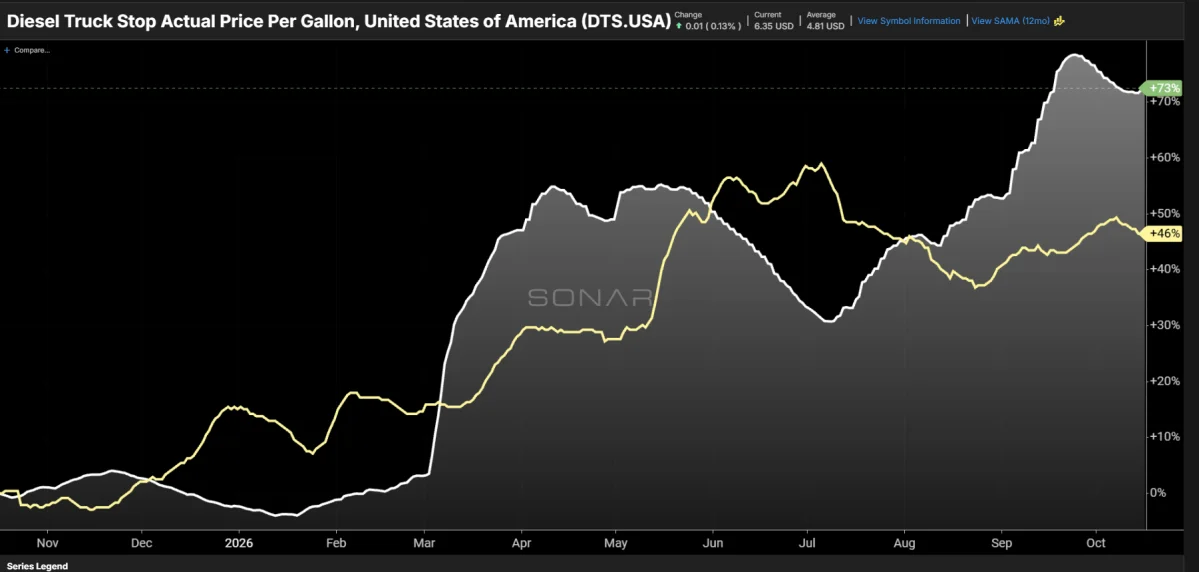
Retail diesel prices are up 73% year over year. Dry van spot rates have risen a still-impressive 43%, but they haven't kept pace with fuel over the past few months. That gap is where carrier margins get squeezed. It's also a pressure that was largely absent in the COVID era, when diesel actually fell in 2020 and rates were doing the heavy lifting.
Carriers that came through the rough stretch from mid-2022 to late last year are cautious about spending. Borrowing costs are much higher than they were, and the low-cost public lending that helped carriers through the pandemic isn't available now. Fleets are protecting their balance sheets rather than buying trucks, and that caution feeds straight back into the capacity numbers.
Supply always moves more slowly than demand. In this cycle it faces more headwinds than in any recent one. My read is that procurement teams should plan for a market that stays tighter for longer, with the possibility that conditions don't normalize until 2027. Locking in capacity commitments early and building contingency into lane plans looks more prudent than waiting for rejections to fall on their own.
What to watch next: whether the ASTVI stabilizes or keeps sliding after the holidays, and whether rejections start to drift lower without a corresponding rise in accepted loads. If rejections fall while volumes stay flat, that would be an early sign of real recovery. Until then, the numbers say carriers are still the ones setting the terms.