1978 Pontiac Trans Am W72/WS6: A Four-Speed Malaise Survivor with Drag-Strip Roots
- Cargo
- Electric Vehicles
- Shipped
- Shipper
- Jim Koscs
- Readers
- 753
A 1978 W72/WS6 Trans Am with a four-speed and a solid roof, traded in by a Queens drag racer who's kept it for decades. Here's why the spec matters.
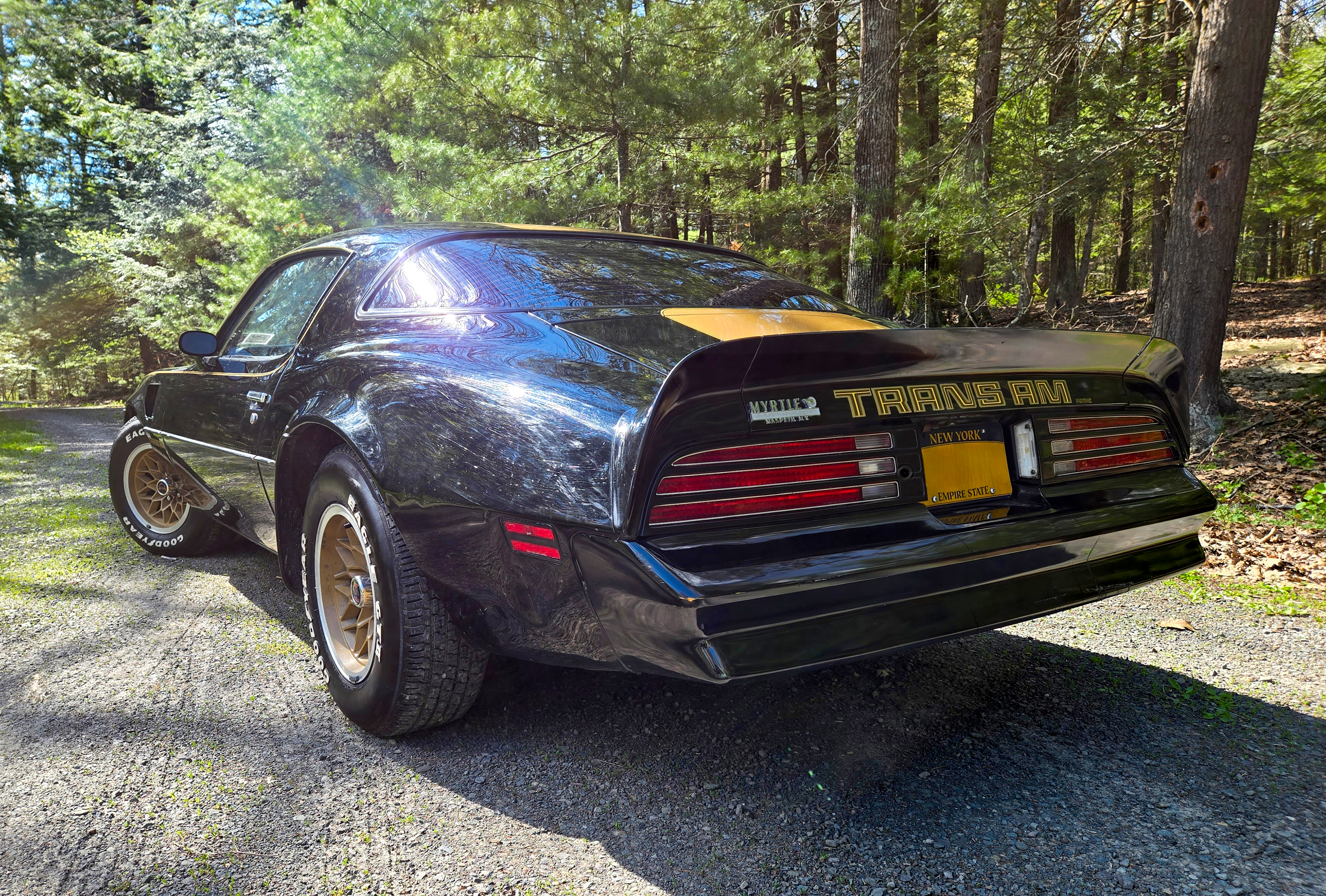
A dealer-ordered 1978 Trans Am usually came loaded with the automatic, air conditioning, T-tops, the stereo upgrade, and the hood decal that enthusiasts call the screaming chicken. The car that Eddie Bloom talked his way into was the opposite. It had a four-speed, a solid roof, and the W72 engine most buyers never ordered. That mix is why a 1978 W72/WS6 Trans Am still gets attention from people who know the model well.

A Trade Made for the Right Reasons
Pontiac and its dealers were moving Trans Ams at a rate that made the mid-to-late 1970s look easy. The Firebird's bird-on-the-hood graphic was everywhere, and black examples were especially sought after once Burt Reynolds ran a Special Edition through Smokey and the Bandit, which finished as 1977's second-highest-grossing film behind "Star Wars." Demand like that puts a premium on the right car at the right dealer.
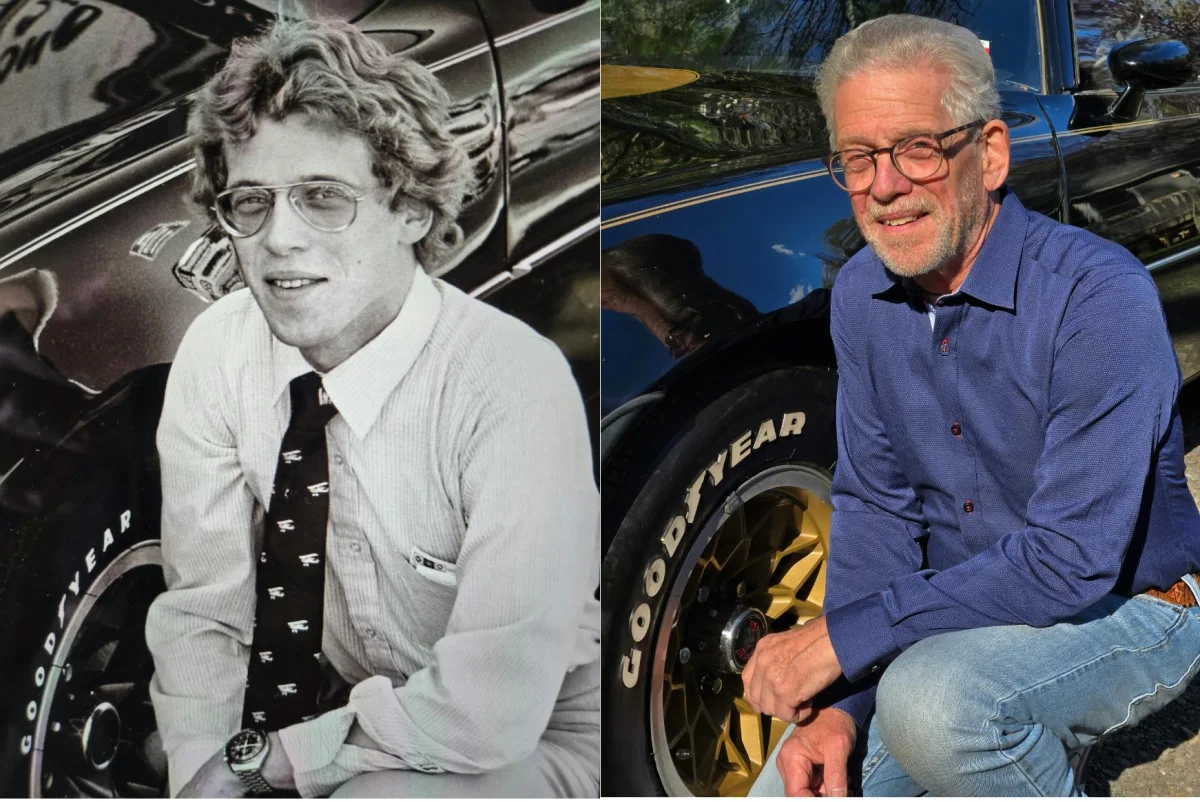
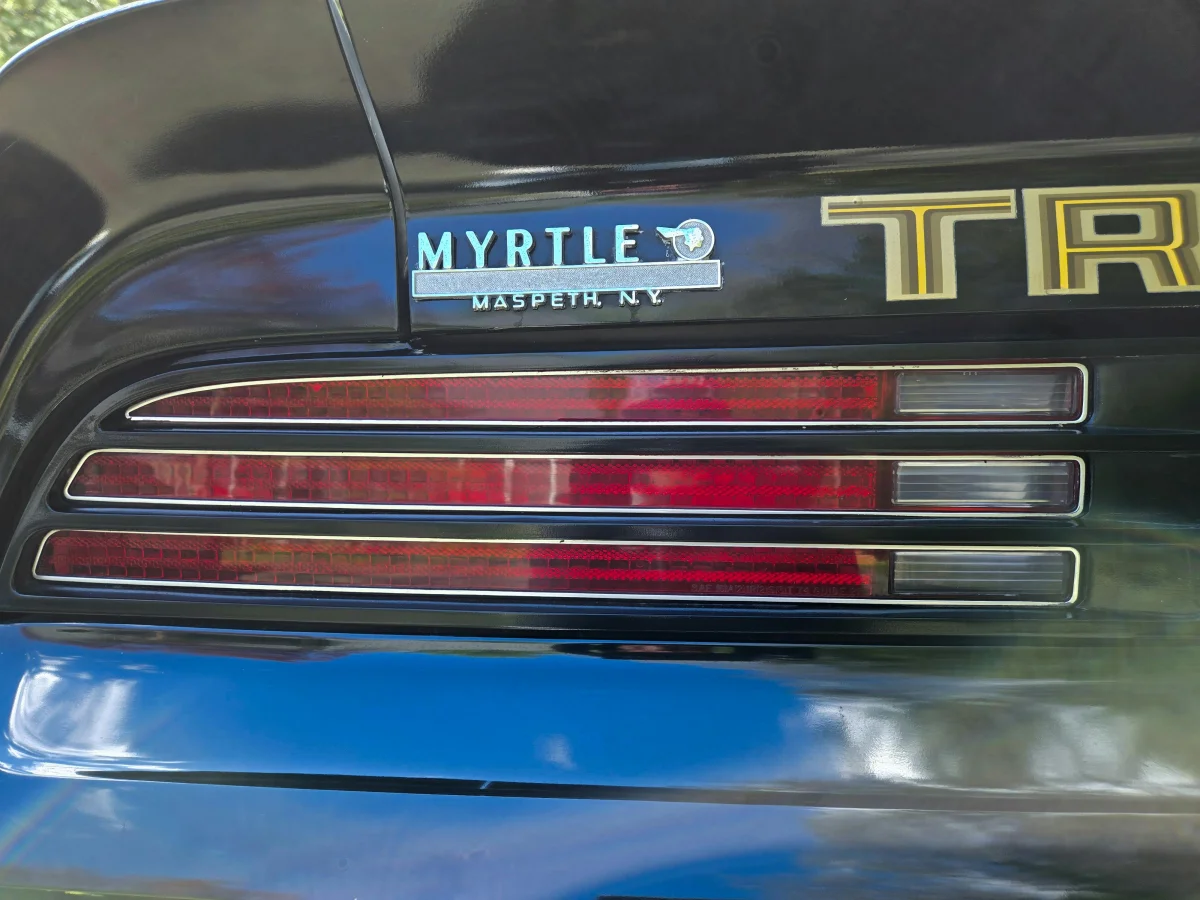
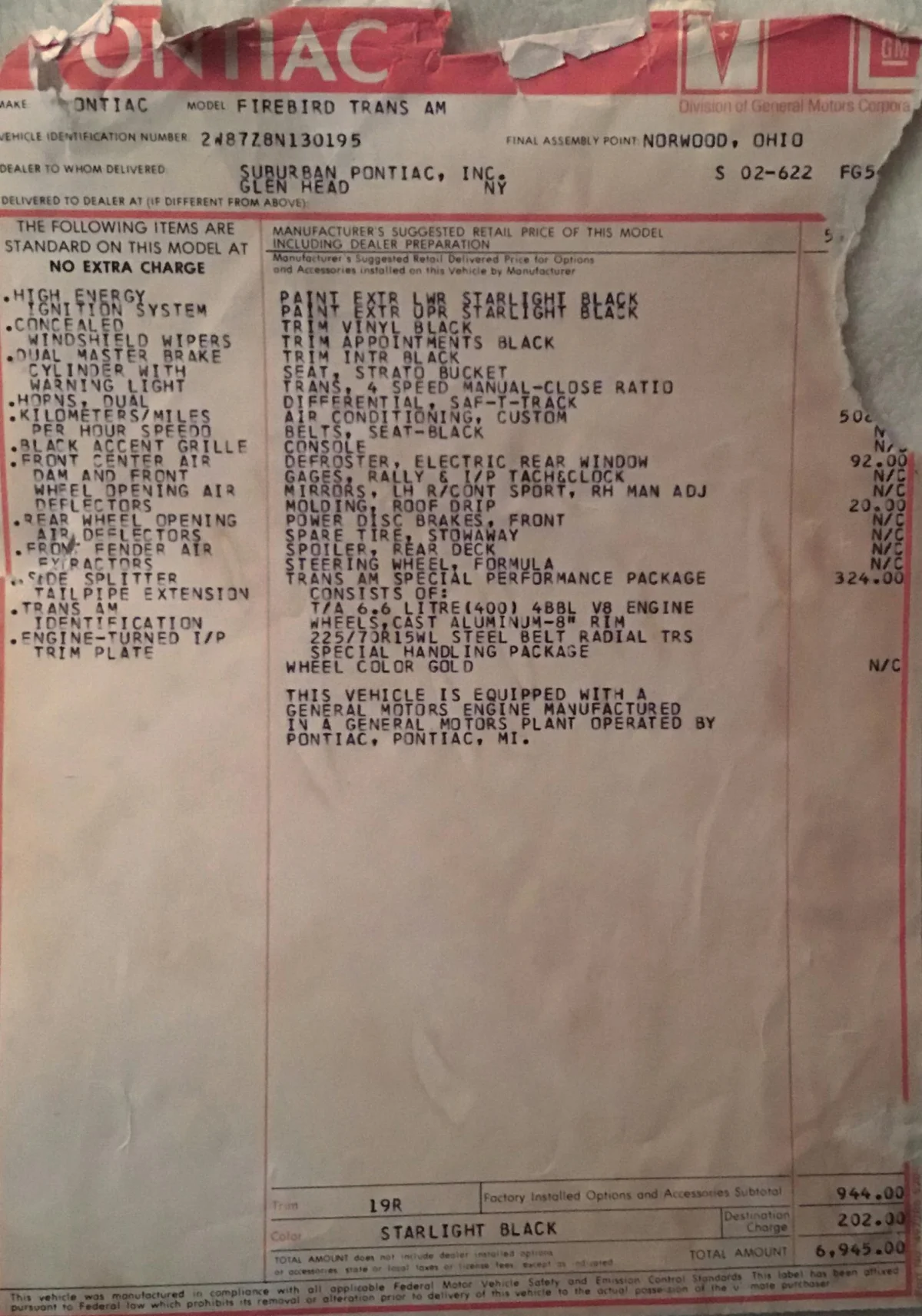
One Starlight Black 1978 Trans Am, a standard car rather than a Special Edition with its gold exterior decal trim, sat for months at Suburban Pontiac in Glen Head, New York, on Long Island's North Shore. Eddie Bloom, then 24 and a drag racer, wanted it badly. He had an advantage most buyers didn't: he worked for his father Eli's dealership, Myrtle Motors in Maspeth, about 20 miles west. Suburban was his uncle's franchise, and part of Eddie's job was arranging car swaps between the two stores.
When Suburban's sales manager called about a Grand Prix sitting on Myrtle's lot, Eddie made his move. The Trans Am had been ordered for a buyer who walked away when it arrived missing some of the options he'd asked for. Suburban was happy to move it. For Eddie, it had the two things he cared about most, a four-speed manual and a fixed roof. Eddie wasn't a fan of the T-top option of the era. "The T-tops were disastrous," he said. "They all leaked."
What the W72/WS6 Package Actually Was
In 1977 through 1979, Pontiac sold the stick-shift only with the T/A 6.6 engine, the W72 400-cubic-inch performance option that replaced the standard L78 400 as the top engine choice. An automatic was standard with the milder L78 and optional with the W72. Eddie's car carried the Trans Am Special Performance Package, which bundled the W72 with the WS6 chassis upgrade that was new for 1978. In period terms, a W72/WS6 Trans Am was about as hot as a Pontiac ponycar got that year.
His father's reaction was predictable. "You traded for this?! Are you out of your mind?!" Eddie recalled him shouting. Eli could read a build sheet at a glance, and he saw the problem right away. Dealer-stock black Trans Ams were ordered with the automatic, A/C, T-tops, stereo upgrade, and hood decal, and that's what sold on the lot. A stripped-down four-speed was a harder sell in a congested metro market where most buyers wanted comfort features. Eddie had only air conditioning, a rear defroster, and roof drip moldings. "We ordered and sold a lot like that," he said of the loaded cars. "You couldn't ask for a better promo than that movie."
Eddie's plan was to use the car as his personal demo. He saw it as a bargain. At $6945 retail, it would have undercut typically optioned Trans Ams by roughly $1500 to $2500, and he figured it delivered Corvette-level performance for a fraction of the L82 Corvette's price, about $3500 less.
The Hot-Rodded Dealer Build
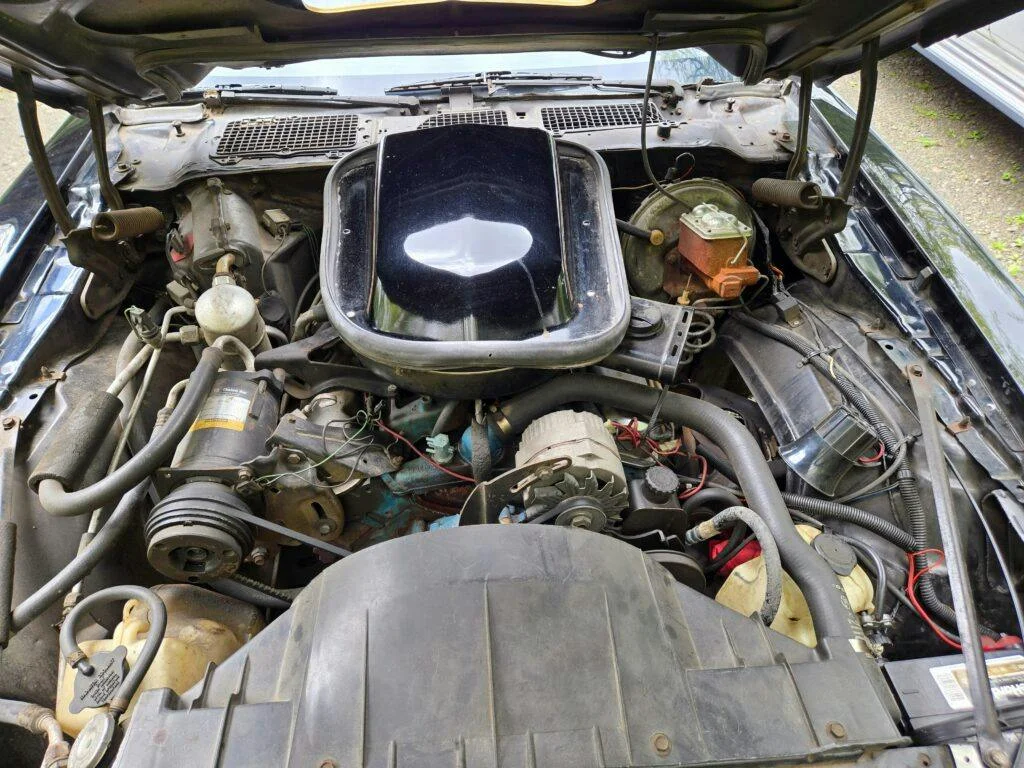
The W72 was Pontiac's last 400, and it left the factory with plenty of fight in it. Eddie didn't leave it alone. With help from dealership mechanics Ed Alessi and Butch Di Lorenzo, who also raced, he added the kind of "day two" upgrades that had made Myrtle Motors a regular stop for Pontiac enthusiasts and racers in the 1960s and early 1970s. Myrtle Motors and its mechanics may sound familiar to readers who followed Frank Kotnik's '76 Firebird Formula.
The team swapped in Pontiac's #068 Ram Air III camshaft with 1.65:1 rockers and retuned the Quadrajet carburetor's jetting. They also removed the catalytic converter. For visual flair, the dealership's touch-up painter put a wide gold stripe down the center of the car, a nod to the era's wilder side without the bird graphic.
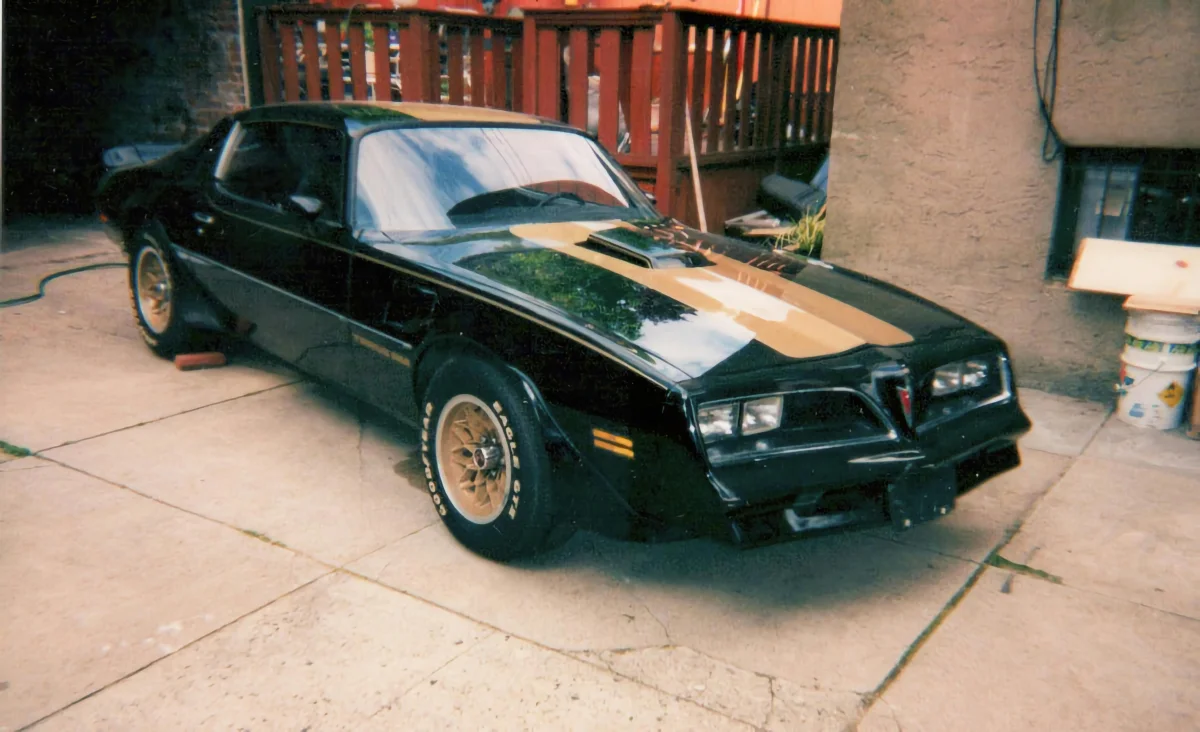
Eddie has driven the car ever since. He ran it at Englishtown a few times. Today it's a cruiser with about 29,000 miles on the odometer and a few scrapes from its Manhattan days. Those miles are a useful reminder that a car like this gets used, not just stored.
Growing Up Around Pontiac Drag Racing
Eddie's grandfather founded Myrtle Motors in 1935. In the 1960s, the dealership began courting the area's racers with Super Duty Catalinas, then GTOs and Firebirds. Eddie, his father, his uncle, and his cousins spent weekends watching drag racing at Roosevelt Field, the airstrip in nearby Garden City, where a flagman ran the show. Their favorite was Harry Wesch, Sr., a skilled mechanic and driver who campaigned a 1962 Super Duty Catalina he had bought from Myrtle.
Wesch later joined the dealership and ran its Hy-Performance Club, a customer program covering speed parts, "Tiger" super-tunes, and powertrain modifications. Myrtle's special-build 428 H.O. Tiger engine swap could run the quarter-mile in 12 seconds in a Firebird or GTO, and that got the dealer coverage in East and West Coast magazines. For a buyer in the late 1960s, the club was a ticket to being the leader of the pack.
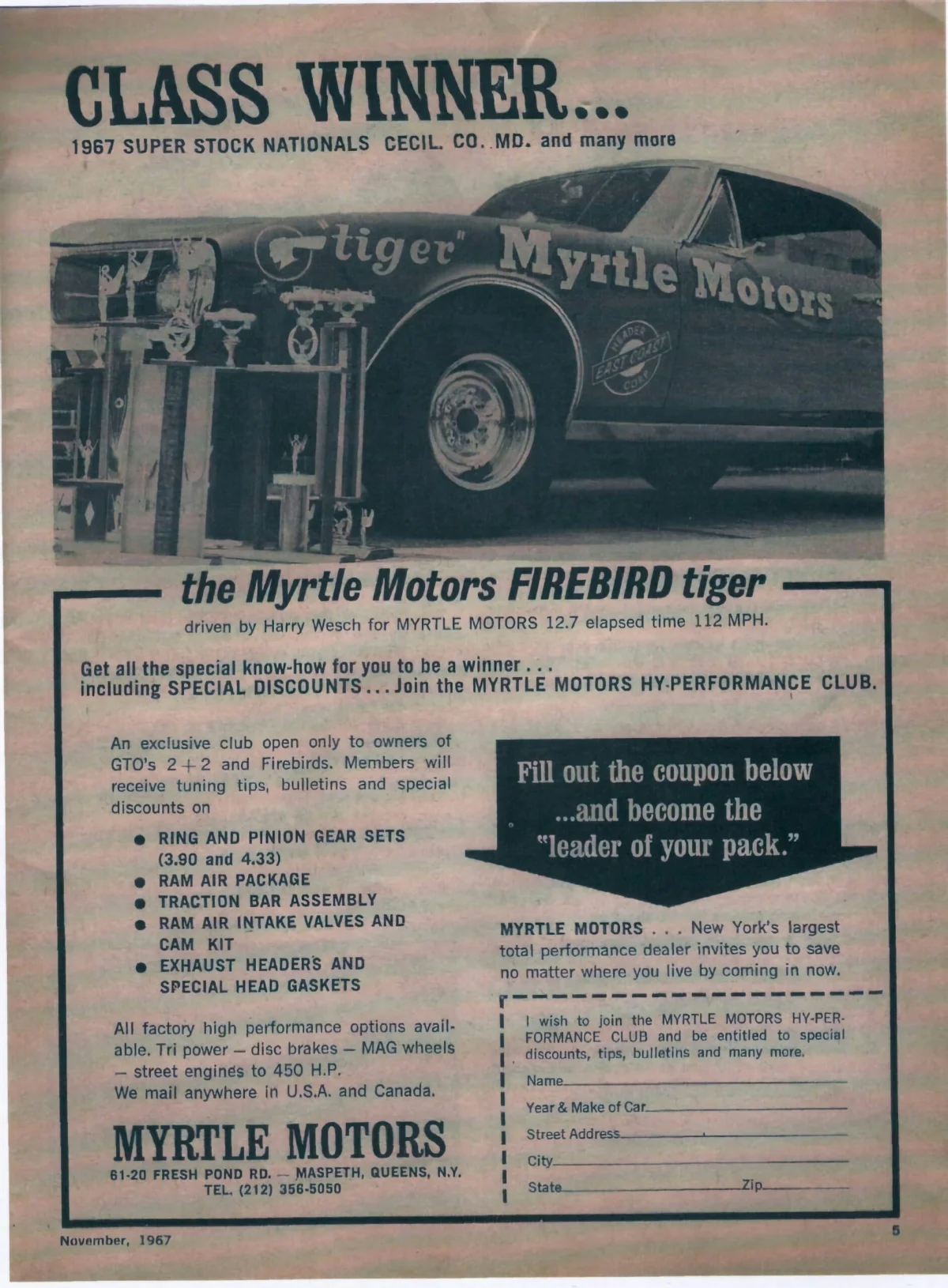
The dealership worked with local speed shops to install cams, valvetrain parts, and shift kits for automatics. It even fielded its own NHRA C/Stock Automatic drag car, a 1967 Firebird from a short run of special cars that Eddie remembers Pontiac building for that class. "They had the first-gen Ram-Air motors, bench seat, and no other options," he said. Wesch raced it hard at National Speedway in Center Moriches and at tracks up and down the East Coast, and it became the car to beat in its class.
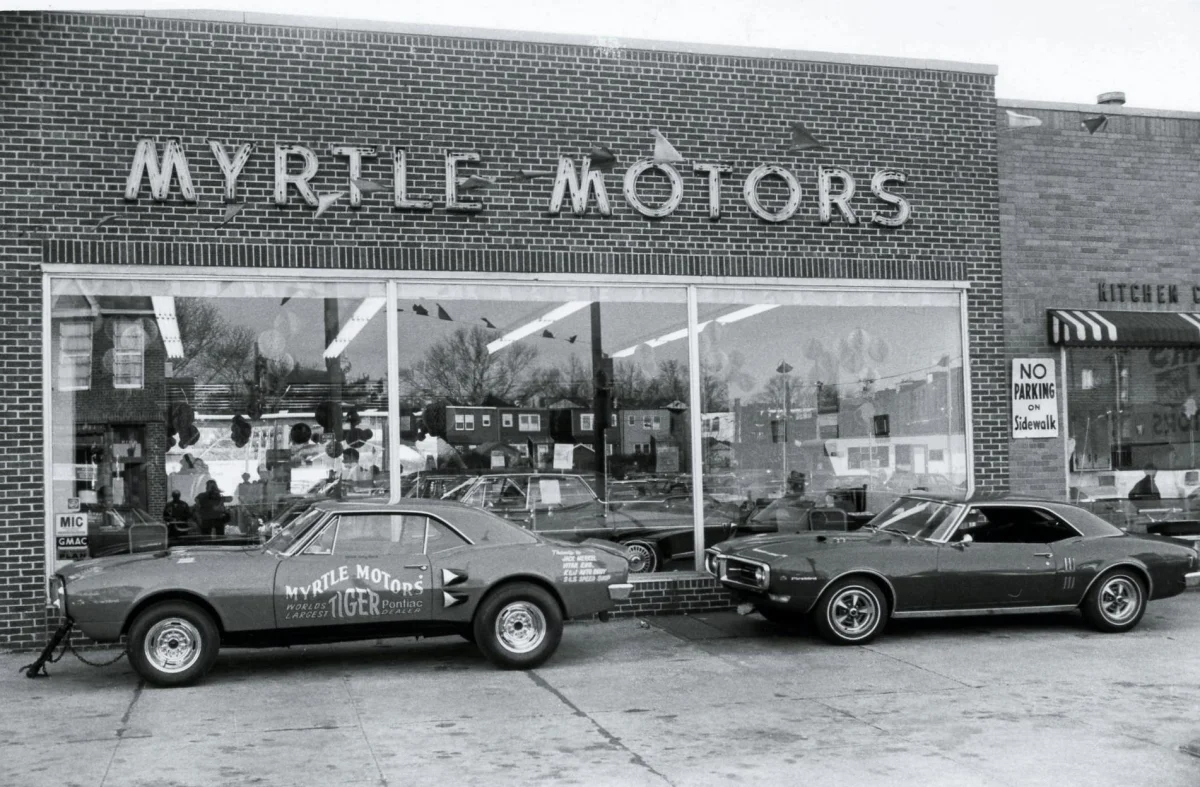
That results sheet caught the eye of Hi-Performance Cars, a New York magazine known for its blunt muscle car tests. Marty Schorr, who later became Buick's long-time East Coast PR representative, was the magazine's editor-in-chief. Featuring Myrtle's work helped balance coverage that had leaned heavily on Pontiac tuners in Michigan, such as Royal Pontiac. "I was glad to have a local Pontiac dealer doing that," Schorr said. "I tried to give coverage to New York area shops and dealerships."
Schorr also knew that street racing shaped the local muscle car market. Brooklyn and Queens had plenty of hot spots, and the scene pulled buyers and business toward dealers with a reputation for speed. "What started out as guys running at Connecting Highway turned into some running for big money," he said. "If you were someone like Harry Wesch, you wanted to be represented at these places, because it brought business into the dealership."
That attention came with its own problems. Wesch once joined the street action in the "Myrtle Tiger" Firebird, with paper taped over the dealer's name on the car. The disguise didn't last, and the scene drew heat. Eddie remembers his father dealing with a stern visit to the dealership, and the racecar was sold soon after. The family took the lesson and moved on.
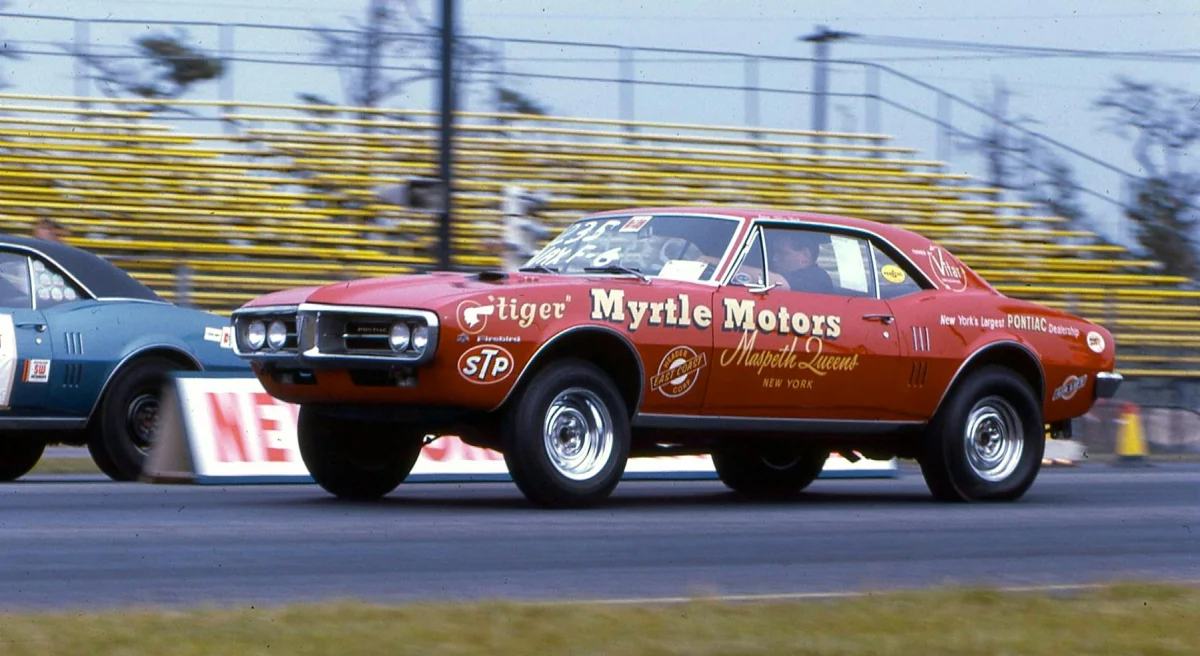
Eddie had his own track days at National with a '64 GTO hot-rodded at Myrtle. He sold it in 1972, when he left for the University of New Mexico in Albuquerque and bought a new GTO. He describes his college years as a long party. "My dorm was on Central Avenue, which was the old Route 66, and it was like American Graffiti," he said. "It was a wild and wonderful time." That run ended in 1977, when his father went to New Mexico and brought him back to New York. Eddie's girlfriend, Cathryn, followed later. The couple celebrates their 45th wedding anniversary this October.
Factory Basics: The 1977-1979 W72 Trans Am
Trans Am sales had been climbing since Pontiac put the giant bird on the hood in 1973, well before Smokey and the Bandit arrived. Emissions rules had squeezed performance by 1976, a year when Trans Am sales still reached 49,000 units. Buyers wanted the look and the attitude, and Pontiac kept finding ways to add horsepower where it could.
When the 200-hp L75 455 V-8 option left after 1976, a replacement was already lined up. A June 1976 dealer bulletin announced a new LS7 400-cube performance package for the 1977 Formula and Trans Am. On the order sheet, it became the W72.
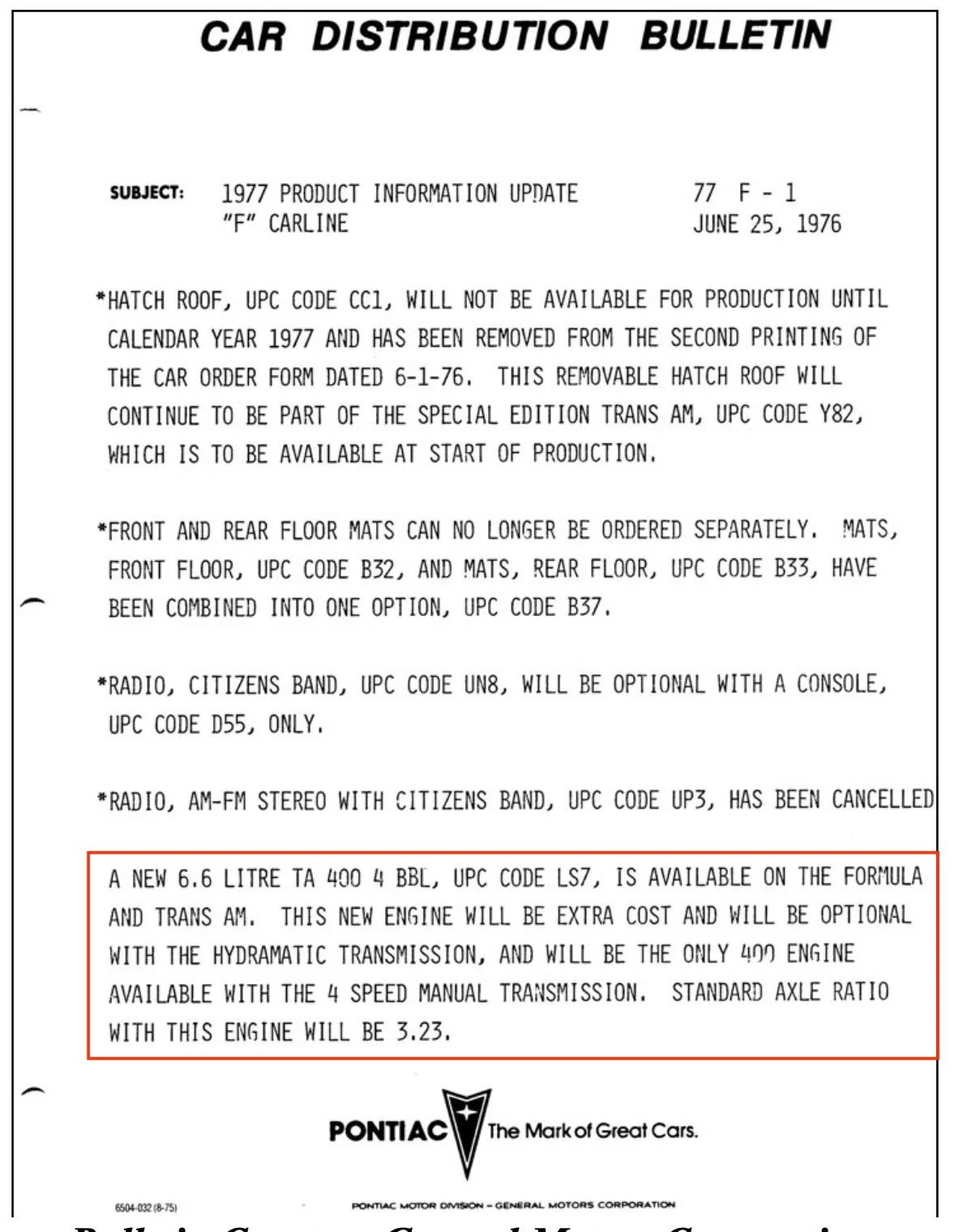
The first-year W72 was offered with either the four-speed manual or the TH350 three-speed automatic. It matched the canceled 455's horsepower and came close on peak torque. It was listed at $50, which was $12 less than the screaming chicken hood decal. On the Firebird Formula, the option cost $205, since it was a bigger step up from that model's standard 5.0-liter V-8.
The W72's extra output came from fairly traditional tuning. Pontiac used cylinder head castings from its 350, which shared the 400's valve sizes but had smaller combustion chambers, raising compression a half point to 8.1. The W72 cam had longer duration than the L78's. Engineers also reworked the 800-cfm Quadrajet four-barrel and the HEI distributor's advance curves to spread the power across a wider rev range.
Durability parts went in too. The W72 got chromoly piston rings, a 60-psi oil pump where the L78 had 40, and a baffled oil pan for harder driving. Chrome valve covers gave it a classic muscle car look. W72 Trans Ams carried "T/A 6.6" decals on the non-functional shaker hood scoop, while L78 and L80 Oldsmobile 403 cars wore "6.6 Litre" badges. With either transmission, the Safe-T-Track limited-slip differential used a 3.23:1 axle ratio. The automatic's converter stall speed and full-throttle shift points were raised, to 4800-4900 rpm against 4200 rpm on the L78.
The W72 sold well. In 1977, 26,177 of 68,744 Trans Ams got it, plus nearly 2500 Formulas. The Trans Am was the most popular Firebird that year, outselling the base and Esprit models combined.
For 1978, camshaft revisions and a new semi-dual exhaust lifted the W72 to 220 hp and 320 lb-ft of peak torque at 2800 rpm. A Y-pipe from the converter split into dual 2.25-inch pipes with dual resonators, replacing the single line that had run to one transverse muffler. Four-speed cars also got a lower 3.42 axle ratio.

The 1978 W72 was first sold inside the Trans Am Special Performance Package with the WS6 chassis upgrade. WS6 brought quicker steering, a thicker rear anti-roll bar, stiffer rear springs, revised shock tuning and bushings, and 15x8-inch cast-aluminum "snowflake" wheels with 225/70R15 radials. Pontiac's aim was clear: give the Trans Am handling that could challenge the Corvette. The package cost $324 on a base Trans Am and $151 on Special Editions, which already included the 8-inch wheels.
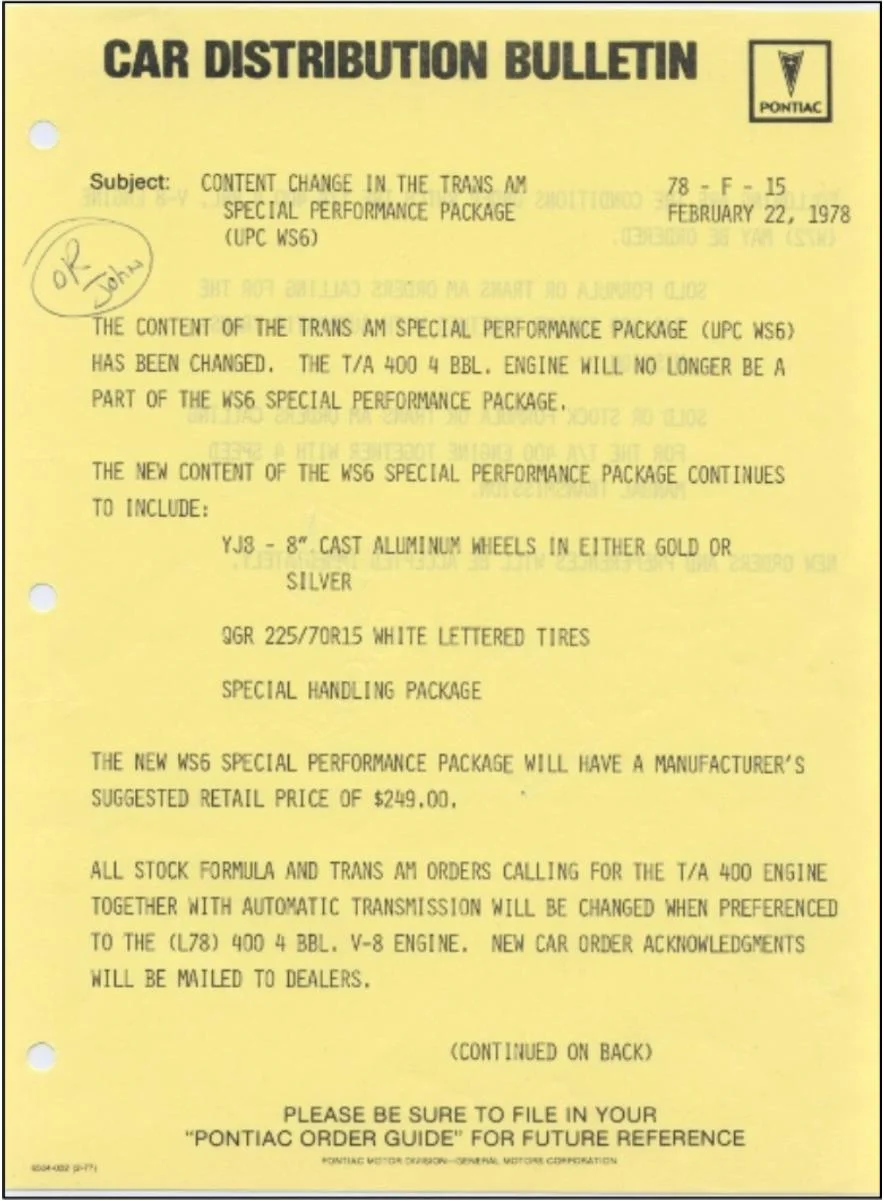
A February 22, 1978 dealer bulletin split the two options. The W72 was priced at $75 and the WS6 chassis and wheel package at $249. If a buyer took both, the window sticker still showed the combined Trans Am Performance Package at $324, according to John Witzke, W72 Firebird technical advisor and historian for the Pontiac Oakland Club International, who shared research for this story.
The same bulletin announced the end of the automatic for the W72. Trans Am sales jumped by more than 35 percent to 93,341 in 1978. Witzke's research shows 33,192 Trans Ams had the W72, with 12,692 of those as four-speeds. Another 1694 W72 Formulas were built that year. Leftover W72 engines went into 8326 Trans Ams and 367 Formulas for 1979. All of those were four-speeds with a 3.23 axle ratio and the WS6 package, now mandatory at $534 total. In hindsight, that looks like a last push before the 400 retired from the Pontiac lineup.
Magazine road tests of 1978-1979 four-speed Trans Ams recorded low 15-second quarter-miles at 93-96 mph. They weren't as quick as some pre-1975 cars, but a W72 Trans Am could still run down a base Corvette and a Camaro Z28. That's a respectable result for a car that was often sold on looks.
Where the Car Stands Now
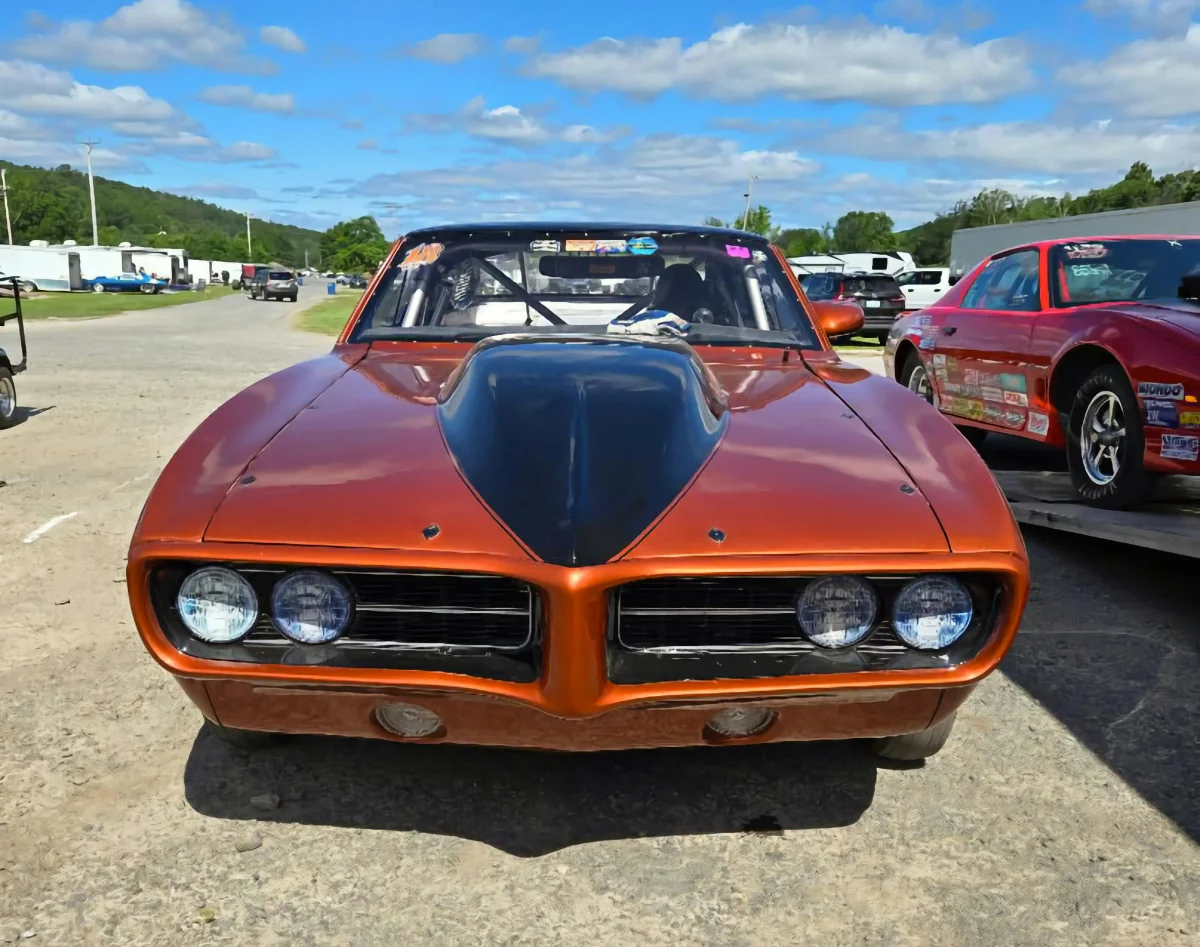
Through the 1980s, Myrtle maintained Pontiac's New York-area media test car fleet. Eddie raced a '68 Firebird at National Speedway, and then he came across a special '85 Trans Am that Pontiac had loaned to Popular Mechanics for magazine modifications. The car came through Myrtle on its way back to GM to be crushed. Eddie bought it as scrap, without a title. He set it up for NHRA Super Stock B/S and drove it through 2012. He still campaigns it with another driver, and he still pilots the '68 in Super Street.
The 1978 Trans Am took longer trips before Eddie and Cathryn had kids, including drives to Charlottesville, Virginia, and North Carolina's Outer Banks. After that, it mostly stayed in the garage. Eddie closed Myrtle Motors in 1992, during a difficult stretch for auto retailing. He redeveloped the property into a successful shopping center and eventually left the car business.
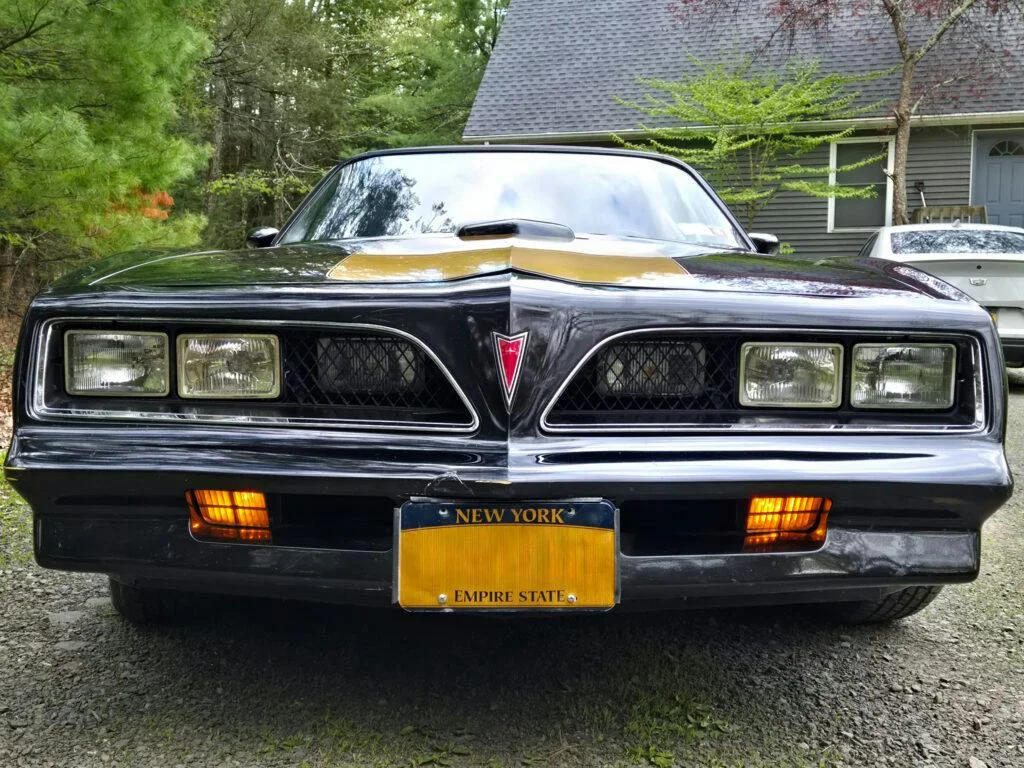
These days the Trans Am lives at Eddie's getaway home in Upstate New York. Every drive brings back memories of fast Pontiacs, drag strips, and the racers and mechanics he still counts as friends. It has also picked up a new job: Eddie takes his teenage grandson out on the area's twisty backroads. When the boy pointed at the stereo Eddie installed decades ago and asked, "What's that?" Eddie answered, "A cassette player." The reply came fast: "What's a cassette player?"
Eddie pulled a tape from the glove compartment, and the tape deck, still working, filled the car as they drove with the windows down and the volume up. "They say you can never have too much fun, but we must always try," he said.
Car: 1978 Pontiac Firebird Trans Am W72/WS6
Owner: Eddie Bloom
Home: Queens, New York
Delivery date: Spring 1978
Miles: 29,000